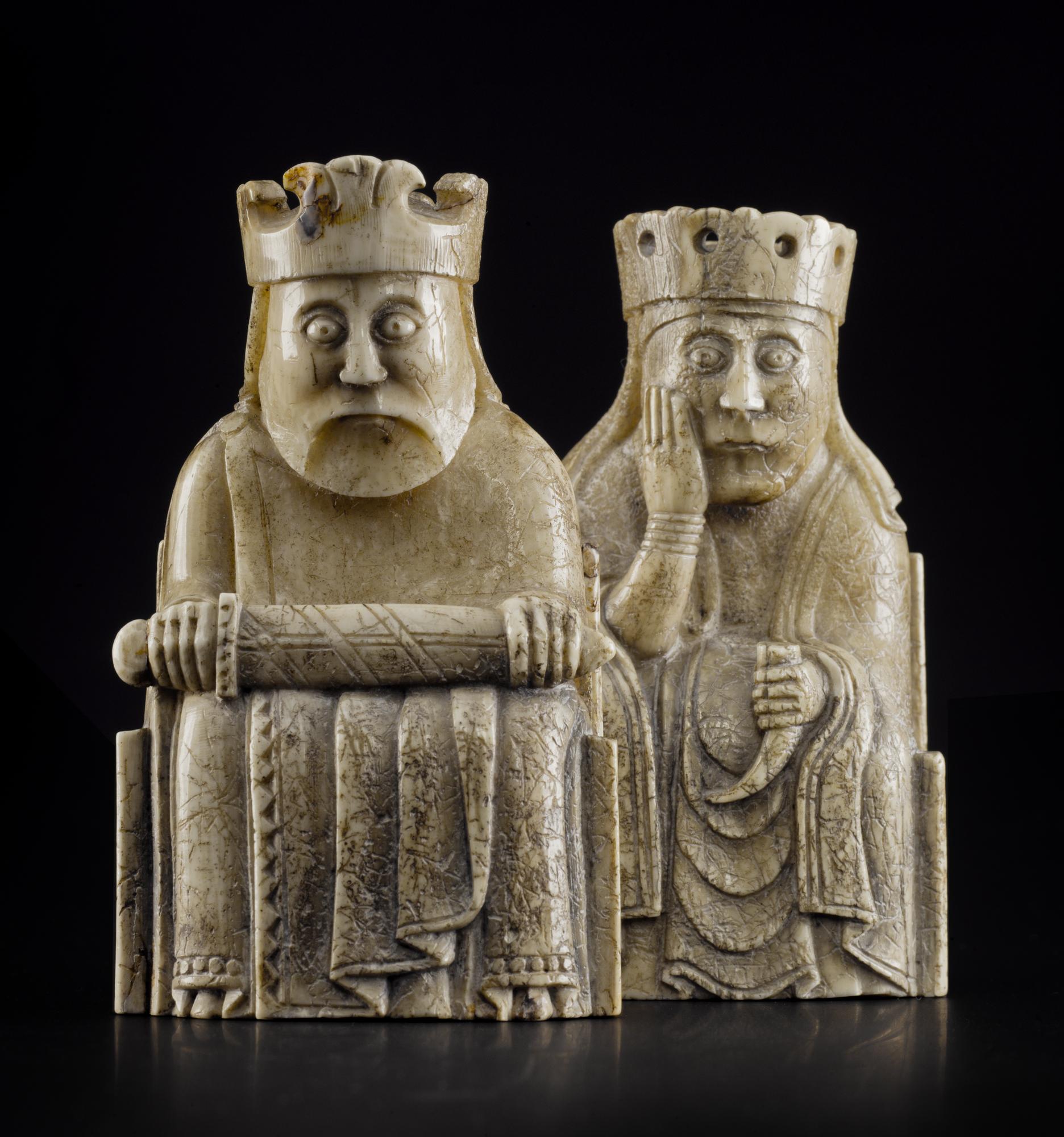
A king and queen from the hoard of chess pieces found on the Isle of Lewis, surely resembling the real-life King Somerled and his wife Ragnhild, daughter of Olaf ‘the Morsel’, King of Man. While his job was to grasp the sword, hers was to hold his cup, for it could not be set down until drained
Excited curators at the Mémorial de Caen in Normandy must even now be unpacking their selection of the famous Lewis chess pieces, which are expected to be put on display there in the autumn. The pieces have been temporarily loaned by the British Museum in exchange for the Bayeux Tapestry, which arrived in London overnight.
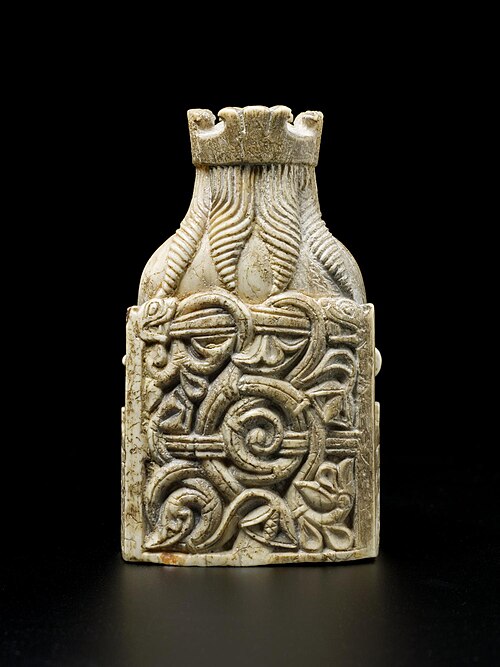 These charming and curious objects, made of walrus-ivory, were discovered in mysterious circumstances on the Isle of Lewis in 1831, on the south shore of Uig Bay, following disturbance to a sandbank. Undoubtedly Scandinavian, probably produced in a workshop in Trondheim, they can be dated (not least from the intricate patterns on the back) to c.1135-70. ‘Most likely they belonged to some merchant who, travelling by land or sea, lost a part of his stock in circumstances we shall never know.’ (Michael Taylor, The Lewis Chessmen, London, 1994, pp.1-7, 11-15.)
The Isle of Man and the Hebrides were part of the wider kingdom of Norway, but were ruled by local kings. The most prominent of these was Somerled, King of Argyll and Kintyre, who, from his base in Lorn (probably in a wooden forerunner of Dunstaffnage Castle), progressively extended his control over the Western Isles, acquiring Harris and Lewis in 1158.
Somerled was the male-line ancestor of the MacDougalls, the MacDonalds and the MacAlisters, as well as of lesser tribes such as the MacIans, the MacGills and the MacEwens of Lochtayside. His Scandinavian name (Sumarliði, ‘summer warrior’) neatly defines him as a Viking, and DNA samples from his descendants have confirmed that he was indeed of Norse origin. Certainly he was raised in a mixed Norse-Gaelic milieu, and dedicated to the acquisition of plunder – especially glittery things with which to impress and reward his followers – yet, according to entrenched family tradition, he was not himself a Norseman but a Gael of the prestigious Clan O’Colla. It is possible, of course, that a ‘false paternity event’ had intervened at some point in his lineage, of which Somerled, and his offspring, had no knowledge. They certainly felt themselves to be Gaels.
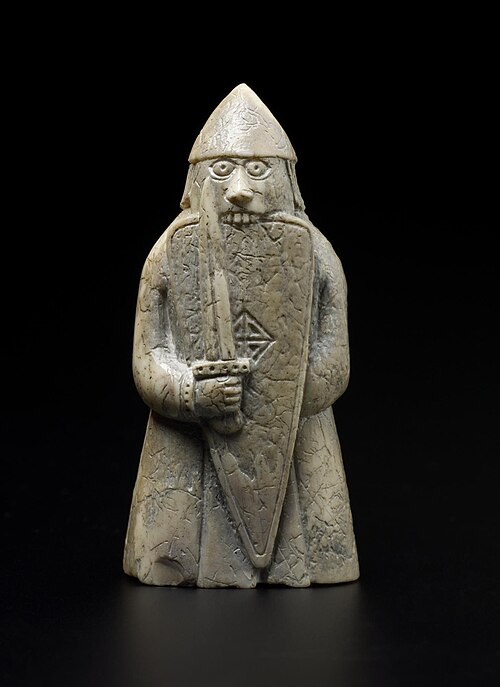 That travelling merchant would surely have regarded Somerled and his family as potential customers. His grandson Donald of Islay, for one, is said to have owned a set of ‘brown ivory chessmen’. (See ‘An Address to Aonghas of Islay’, in O. Bergin, Irish Bardic Poetry: Texts and Translations, together with an Introductory Lecture (Dublin, 1970), No.45.) In the various representations of the king, they might even have seen portraits of themselves. They are robed and crowned and hold swords across their knees with both hands. The kingly fashion was for beards and for shoulder-length hair, worn in thick braids, but tied up in bands before battle. In his fiercer moments, Somerled may even have resembled the ‘berserker’ rook, who, wild-eyed and furious, bites his shield in anticipation of the coming battle.
The last of these, for Somerled, was an attack on the Stewart castle at Renfrew, where he perished, in 1164: ‘Wounded by a spear, slain by a sword,’ according to one account; though another has it that he never made it out of his tent, having been killed by his page before the battle had even begun.
Clan Somerled, my exhaustive account of King Somerled and his descendants, the MacDougalls and the MacEwens, is currently in preparation.
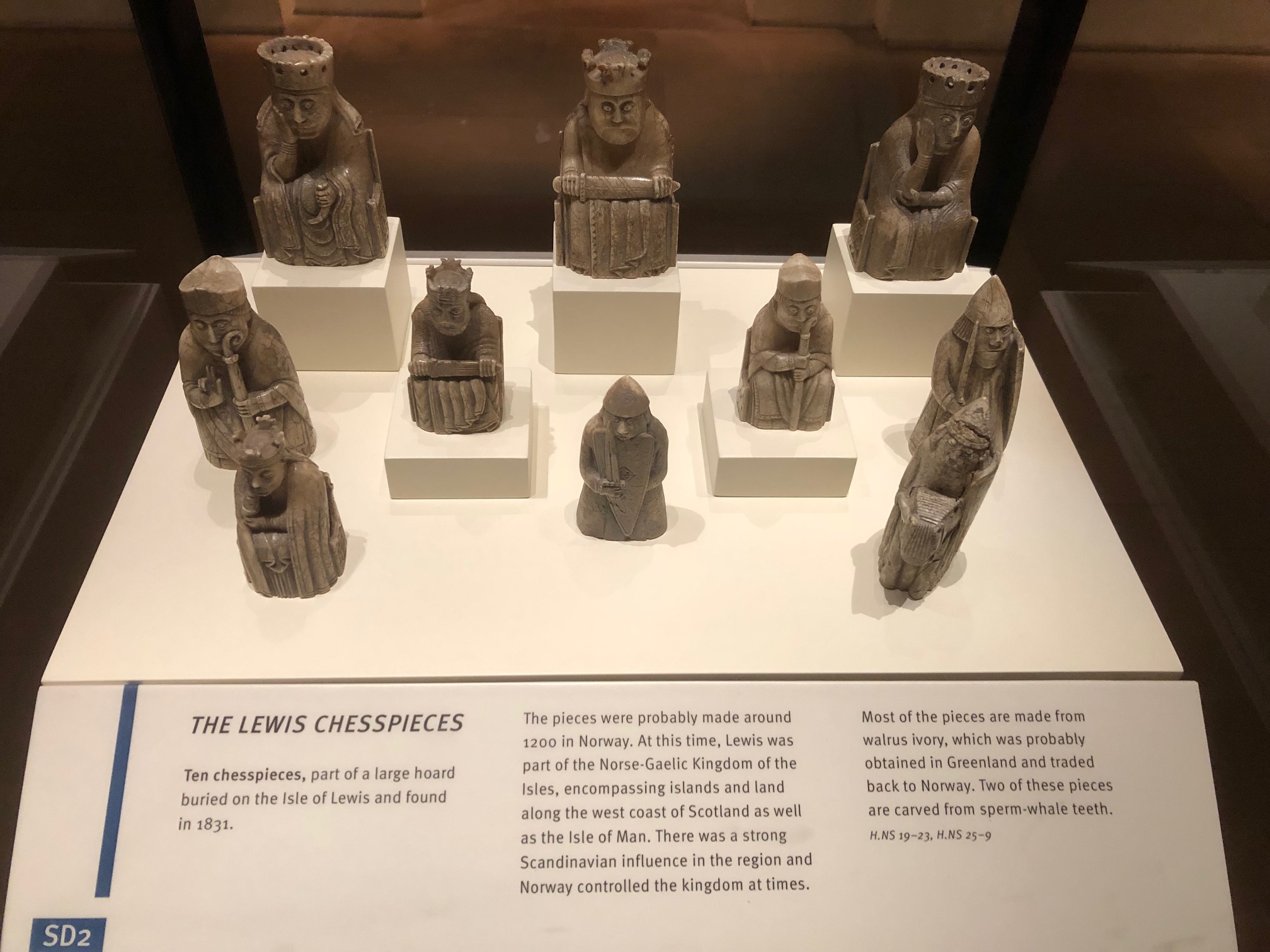
Part of the original collection has remained in Scotland and is now in the National Museum in Edinburgh

