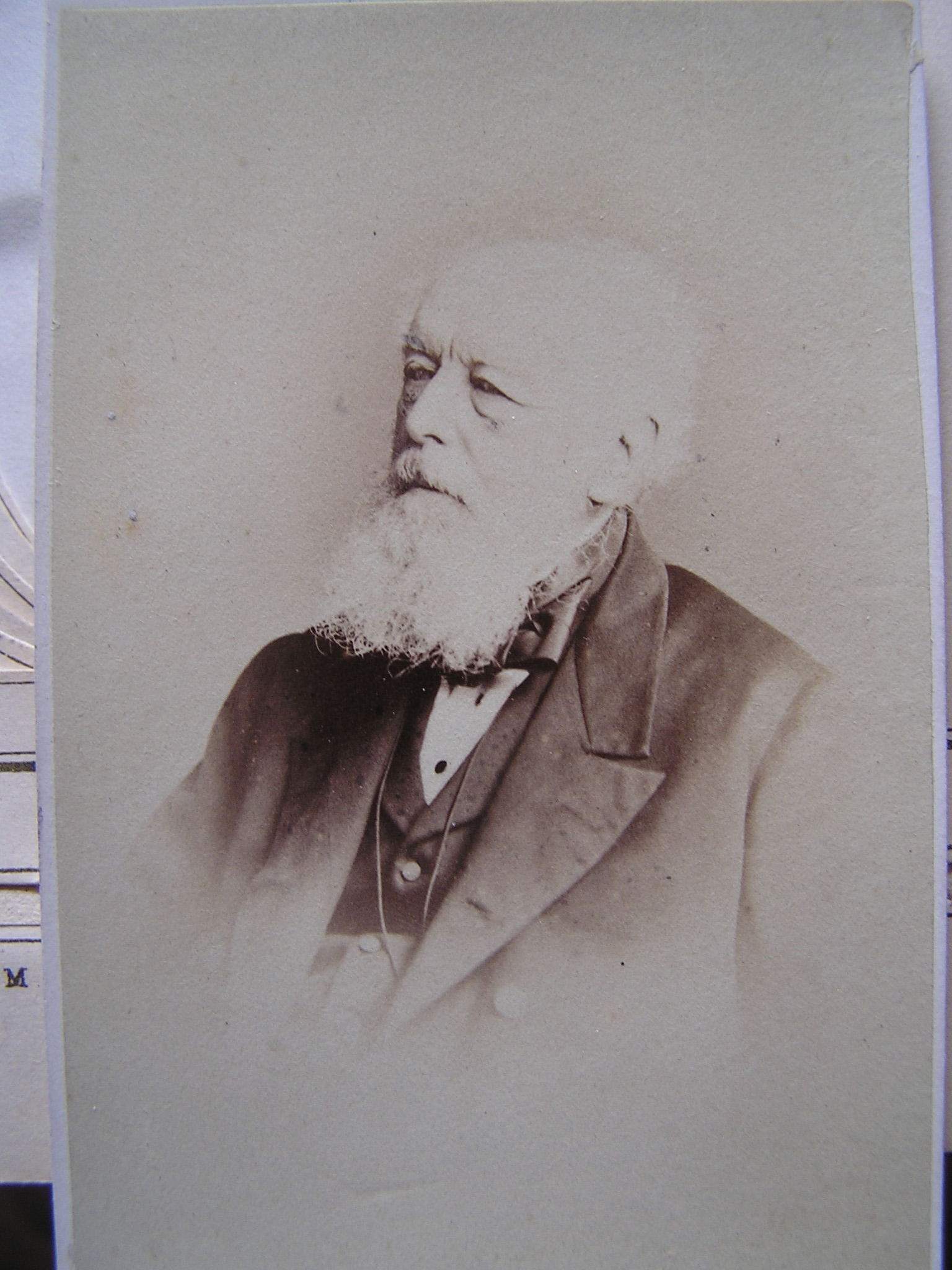
General Sir John Hackett, “I Was a Stranger”, and the van Nooij Family of Ede

January 11th, 2012

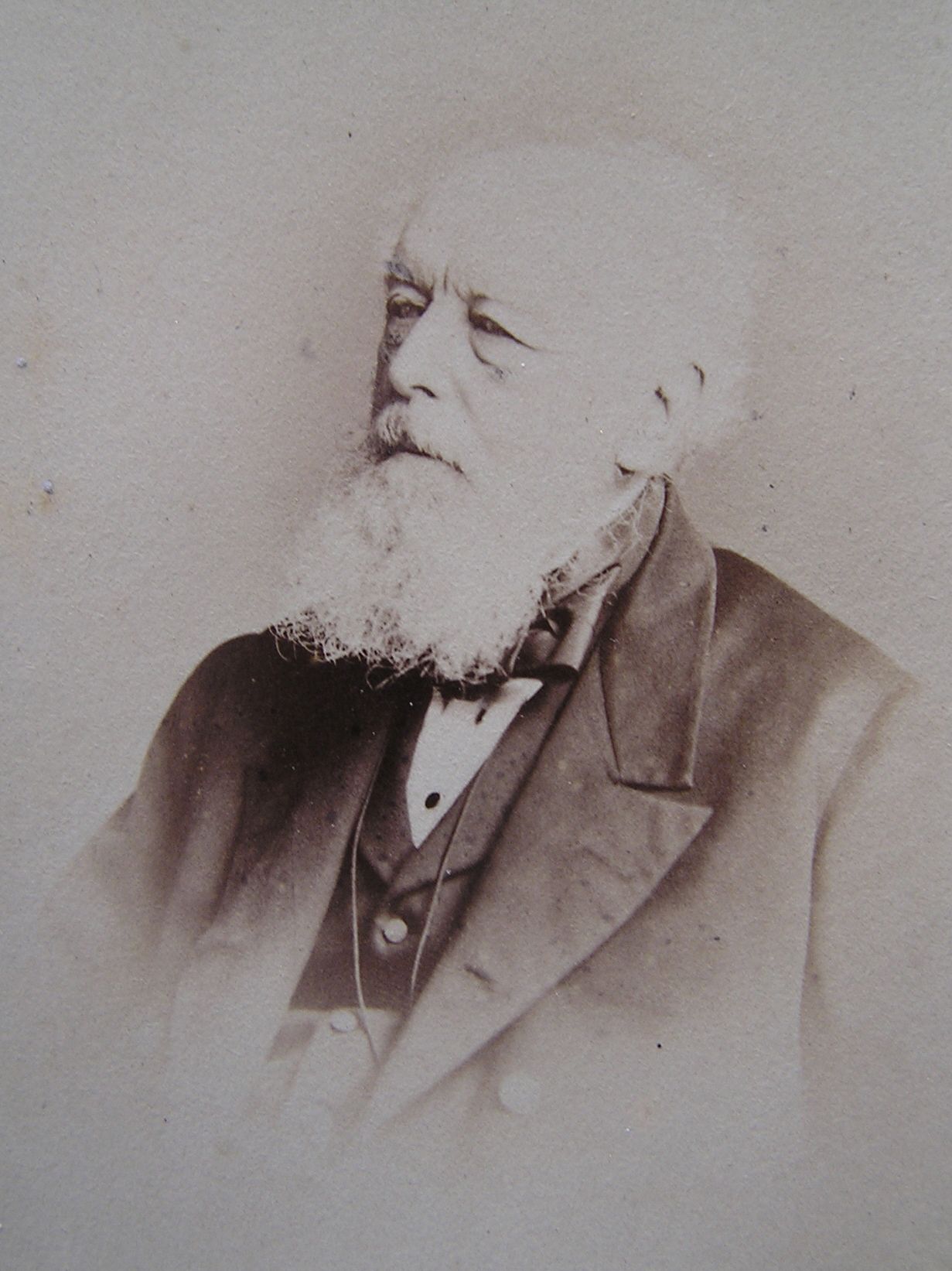
On 24 September 1944, the 33-year-old Brigadier John Hackett, commanding the 4th Parachute Brigade, was severely wounded by a shell splinter at Arnhem. He was taken to a German-controlled hospital, where a brilliant British Army surgeon performed a life-saving operation. Two weeks later, when his removal to a P.O.W. camp seemed imminent, Hackett was spirited away by members of the Dutch Resistance.

Hackett recuperated for four months in the house of the van Nooij family at nearby Ede. The household consisted of three unmarried sisters and their niece and nephew, an active résistant. A typical, closely-knit Dutch family, ‘unassuming, prosperous and provident’, they had never harboured a British escaper before, but, to Hackett’s surprise, greeted him ‘as though we were all old friends’. As he soon discovered, they were all remarkable in various ways.

The tall, fair John was cool and courageous; Mary, his sister, never spoke a word ‘that was not good tempered and kind’. The eldest of their aunts, Miss Mien, was witty and wise; the imposing Miss Cor was clever and highly-strung; whilst Miss Ann, who spoke perfect English and exuded moral authority, was ‘one of the sweetest-natured and most charitable people I have ever known but at the same time a woman of great determination. Like nearly all others in that family she was a devout Christian.’

Confined to an upstairs bedroom, Hackett – who had read ‘Greats’ at Oxford and written a thesis on Saladin while serving in Palestine – spent his days reading Paradise Lost and St Matthew’s Gospel in Greek. He was told that the Germans were ‘everywhere’, and one day was casually informed, as if it were ‘something of no very great significance’, that a detachment of Feldgendarmerie was billeted not thirty yards away. ‘Cautious habits,’ he wrote, ‘became second nature’.

With food and clothing in desperately short supply, the electricity cut off and temperatures that winter dropping to minus fourteen, Hackett was taken aback by the ‘feeling of goodwill and kindness’ that was ‘always present in that house’. He would usually descend for meals, when grace would be said and a passage read from the Bible, as it would be again before bed. Hackett wrote of his birthday – marked by special renditions of ‘Abide With Me’ and the National Anthem, including all the later verses – that the ‘air was full of kindness, goodwill and hope. When they left me I wept unashamedly. It was no longer possible to regard [them] as any but my own family.’

The task of hiding, protecting and nursing a wounded British officer – and ultimately of arranging his escape – was an exacting one indeed. ‘The penalties for harbouring allied fugitives … could scarcely have been more severe. Carelessness or ill-luck, a simple mishap, might at any time destroy them. This would be their reward for taking in a stranger. Yet they went about their daily lives calmly and cheerfully and never showed to me, the cause of the mortal danger in which they stood, anything but solicitude and kindness. There was no trace of fretfulness. If any of them longed for their guest to be gone, and the threat removed which was embodied in his presence, they gave no hint of it. There was no appearance of anxiety in that household, no sign of fear, no tension. The atmosphere was one of confidence and trust and sometimes there was even gentle mirth. My admiration for these people touched on awe.’

Hackett was astonished by the bravery of the women. When German soldiers hammered on the door, intent on searching the house for clothing and blankets, Aunt Cor, with exquisite timing, feigned an attack of hysterics. Hackett cautiously looked out of the window and saw the Germans ‘almost slinking away from the door. A cloud of defeat brooded over their heads’. On another occasion, Aunt Ann, accompanied by Hackett on an evening walk, pushed her way through a crowd of German soldiers in order to post some incriminating letters. Hackett could scarcely believe his eyes; yet, as they walked away, ‘Ann de Nooij’s demeanour was as untroubled as if she had done no more than a little household shopping’.

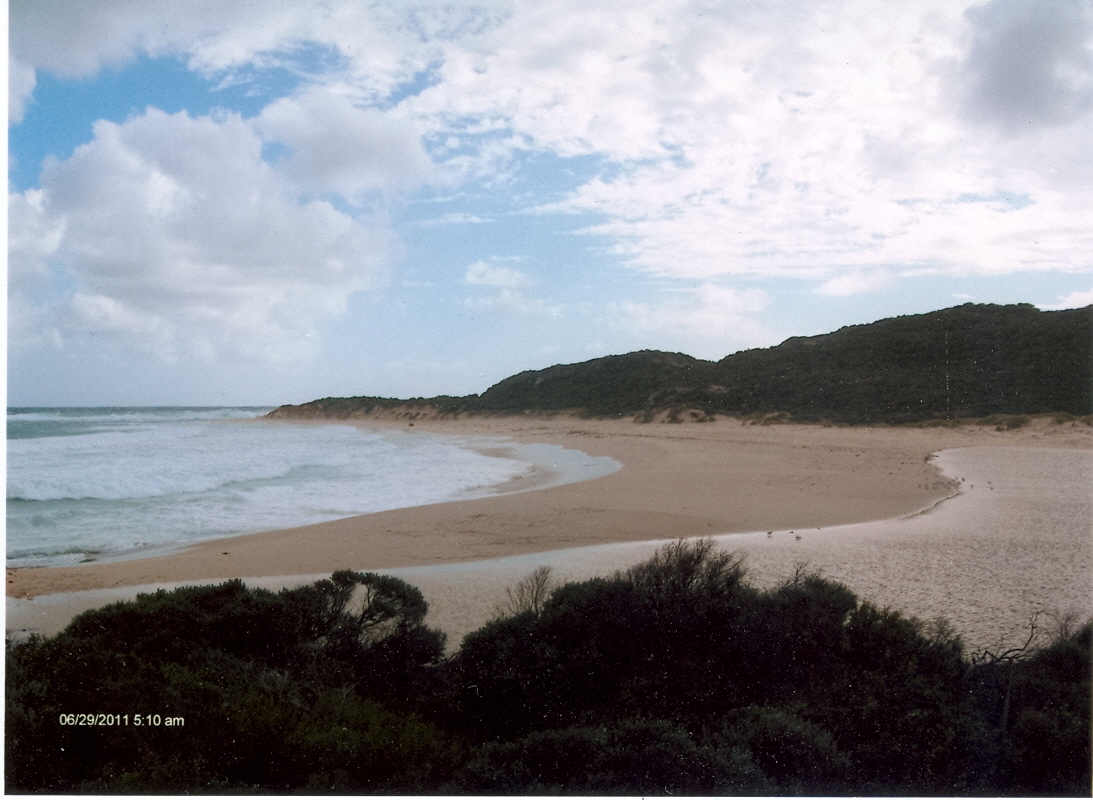
The future General Sir John Hackett’s eventual escape to the coast (on an ancient bicycle) is thrillingly described in his remarkable, compelling narrative of these events. First published in 1976, this incredibly moving, unforgettable book is perplexingly out of print, but second-hand copies are easily obtainable. Its title, I Was a Stranger, is taken from Matthew, 25, vv.35-40, one of the most profound and impressive statements of Christian conduct: ‘I was an hungred and ye gave me meat: I was thirsty and ye gave me drink: I was a stranger and ye took me in: Naked, and ye clothed me: I was sick and ye visited me: I was in prison, and ye came unto me … Verily I say unto you, Inasmuch as ye have done it unto one of the least of these my brethren, ye have done it unto me.’ Hackett was himself a man of deep faith, from a devout family; his recent forebears, pioneering settlers of South Western Australia, had built the church at Busselton – where his parents were married and he himself was baptised – with their own hands.

He parted from his dear friends at Ede with reluctance, a changed man. ‘I was leaving behind me a rare and beautiful thing. It was a structure of kindness and courage, of steadfast devotion and quiet selflessness, which it was a high privilege to have known. I had been witness to an act of faith, simple, unobtrusive and imperishable. I had often seen bravery in battle. I now also knew the unconquerable strength of the gentle.’

A detailed account of ‘Shan’ Hackett’s ancestry – in Jamaica, England and Australia – is included in Chapter IV of my recent book, Basingstoke and its Contribution to World Culture. He was himself descended from a long line of redoubtable women, among them a grandmother, Grace Bussell, who is famed as the ‘Grace Darling of Western Australia’.

I am grateful for the link to this post on the excellent http://www.britsattheirbest.com/

When Adam Put on Breeches: Shelley, Byron and Jane Austen as Swimmers, and the Invention of the Swimsuit

December 5th, 2011

According to my fellow blogger, the historical novelist Catherine Delors, eighteenth-century Parisians liked to bathe naked in the Seine, notwithstanding the ‘horrendous pollution’ of the river. Apparently this popular summer pastime was banned after the Revolution, for both men and women. So much for ‘liberté’!

Parisian swimmers reluctantly took to wearing costumes. Catherine reproduces a fascinating print (above) of c.1810-15, from a series called Caricatures parisiennes, in which those of the men are exactly like modern bathing shorts. The women appear to be covered to the knee, apart from their arms, and are wearing caps. For both sexes there is a relatively high exposure of naked flesh, but the prudes of the later nineteenth century would see to that!

Likewise in Britain, the few men and women who had the leisure and inclination to bathe had traditionally done so in the nude, but this was increasingly frowned on. Men and women were still swimming naked together off Weston-super-Mare in the early 1870s, much to the delight of the diarist Francis Kilvert. However, the sexes were increasingly being segregated under local by-laws, as at Shanklin, which Kilvert visited two years later. At such stuffy resorts, nudity was strictly forbidden.

Followers of Catherine’s blog have wondered what Byron would have worn for his epic crossing of the Hellespont that took place at exactly the time of the print (3 May 1810). The poet Shelley, who was a non-swimmer but loved to immerse himself in homage to classical models, always did so naked, ‘just as if he were Adam in Paradise before his fall’. Surprisingly, his future wife, Mary Godwin, strongly disapproved. When, on their way through France, Shelley insisted on stopping to bathe in a stream, she firmly declined to join him, declaring that it would be ‘most indecent’. In Italy, where men, women and children all bathed happily together in the nude, Mary, again, steadfastly refused to take part. To do so, she said, would be ‘improper’. Mary may thus have represented changing attitudes, the trend towards Victorian prudery, notwithstanding that she had been unashamed to elope, at seventeen, with a married man. It is equally possible that she suffered from acute self-consciousness in respect of her own body – unlike her step-sister, Claire Clairmont, whose willingness to bathe naked can only have made her more interesting to the poet.

As for the club-footed Byron, neither his post-swim letter to Henry Drury nor his lines Written After Swimming From Sestos to Abydos includes any reference to his attire. However, Charles Sprawson states in Haunts of the Black Masseur: The Swimmer as Hero (London, 1992), pp.103-4, that Byron ‘always wore trousers to conceal his disfigurement. Only in swimming could he experience complete freedom of movement.’ I do not know on what evidence he bases this assertion, nor whether the poet’s companion, Lieutenant Ekenhead, discarded his drawers for the occasion.

It would be even more interesting to know whether Jane Austen wore anything when bathing off Lyme in 1804: as she writes to her sister, Cassandra, on 14 September – surprisingly late in the year for sea-bathing – ‘The Batheing was so delightful this morning & Molly so pressing with me to enjoy myself that I believe I staid in rather too long …’ (The Letters of Jane Austen, ed. Deirdre Le Faye (Oxford, 1996), p.95).

Read Catherine Delors’s article at http://blog.catherinedelors.com/swimsuits-in-1810-paris/

Grateful acknowledgement is made to Susan Holloway Scott who examines the print at http://twonerdyhistorygirls.blogspot.com/2010/08/men-women-swimming-togetherin-1810.html

Walter de Merton, Son of Basingstoke, Rector of Kingsclere

November 22nd, 2011

I am greatly looking forward next month to addressing the Kingsclere Village Club, for the second time (Thursday 15 December, 7.30). My talk will be entitled ‘Basingstoke and its Contribution to World Culture’. There is a synopsis on my ‘Lectures’ page.

There are interesting historical links between the two towns. The rectory of Kingsclere was once held by Walter de Merton. Bishop of Rochester and Chancellor of England in the 1260s. Walter was a native of Basingstoke, born on the property later known as ‘Merton Farm’. The site of the farm has been buried since the 1960s under the vast concrete ‘superstructure’ that blights the town. Specifically, ‘The Malls’, one of Britain’s least popular retail centres, looms above it. Merton Farmhouse was precisely situated beneath that unlovely feature, the ‘Great Wall of Basingstoke’, an ugly staircase (pictured above) marking the exact spot.

It is regrettable – to say the least – that Walter should be barely remembered in his home town. His great foundation, Merton College, Oxford (pictured left), was the first self-supporting and self-governing university college in England, the model for all that have followed.

As for Kingsclere, Walter was a pluralist and probably had little to do with it, but others of his family were to forge a strong link. Walter’s maternal aunt, Margaret FitzOliver, married William Chasteyne de Kingsmill – the royal mill in Basingstoke, which had been granted to the family by King John. The ‘Chasteynes’ or Castons were well-known in Basingstoke until the 19th century. Their memory is preserved in Caston’s Yard. They also had an early connection with Kingsclere, owning, until 1322, a hall house next to the church. It was the forerunner of the present Falcon House, which, itself bent with age, is now one of Kingsclere’s most historic buildings.

Furthermore, the descendants of William and Margaret Chasteyne de Kingsmill include the Kingsmills of Sydmonton, whose grand tombs (left) are in Kingsclere Church. These Kingsmills were rich merchants. As well as rebuilding Sydmonton Court in the reign of Elizabeth (for the future enjoyment of Lord Lloyd-Webber), they retained an impressive town-house in Winchester Street, Basingstoke. It was fit to receive Katharine of Aragon in 1501, on her way up to London for her first wedding. Sold out of the family after the Civil War, the Winchester Street house may have been converted (by 1671) into an inn, the ‘Maidenhead’.

I have a theory that this historic building still exists, albeit heavily disguised under later accretions. If my identification is correct, it today houses a betting agency, a charity shop and a laundry: for further details, refer to my ‘News’ page. Its survival would more than compensate for the loss of Merton Farm.

I shan’t mind at all if members of my Kingsclere audience want to invest in my latest book, Basingstoke and its Contribution to World Culture, on which the talk is based. It is designed to be the perfect stocking-filler, so I shall bring some copies just in case. For details, please refer to my ‘Books’ page.

The Nea Mone, Chios – and the Vagaries of Levantine Travel

November 10th, 2011

Further to my last blog, the Nea Mone, Chios, was not quite deserted when I visited it on Thursday 10 October 1991, as I was reminded on re-reading my diary of the journey.

The previous day I had lunched with elegant Greek friends in Athens, before embarking at Piraeus on the Sappho, bound for Chios at 7 o’clock. I describe the ‘hellish atmosphere’ on board, ‘my class in one communal room with bar & food, television. Shortage of seats, which were cramped & uncomfortable. Many Turks, gipsies (one dirty boy begged from me) and soldiery. Slept badly …’

All was well on my arrival at Chios town. It had a ‘very Turkish atmosphere. Shacks built on top of the ramparts. Giustiniani Museum with a few Byzantine relics.’ On Thursday afternoon, the redoubtable Pandeles Spanos (‘the beardless’) drove me ‘up mountain to Nea Mone – sick-making hair-pin bends, a long drive to a very remote place …’ Pandeles thought we should delay our arrival till 3.45, as the monastery would surely be closed ‘for a long lunch’. He proved to be an enthusiastic and knowledgeable guide. ‘A kindly old monk supervised in the church – an illiterate.’ Pandeles ‘explained that I was a writer of Byzantine history, about which he was unfortunately ignorant. Later another, younger monk appeared, & an elderly nun, who gave me Turkish Delight & a cup of water. She had seemed charmed when I doffed my hat to her & also when I said the sweet was “nostimo” – delicious.’

We ‘went on to Anavatos, a desolate, haunted place, inhospitable enough even when inhabited’.

It is strange that my strongest memory of this day should be of seeing the Emperor Monomachos’s prayer book, and that, of all details, I should have omitted to mention this in my diary.

Constantine IX Monomachos, Zoe Porphyrogennete and Maria Skleraina: An Imperial Ménage à Trois.

October 31st, 2011

The Byzantines frowned on second marriages. They were permissible only when the first marriage had been childless. Third marriages were contrary to both ecclesiastical and Roman law, and to marry a fourth time was, according to the Patriarch Nicholas I Mystikos, ‘a bestial act only worthy of lower animals’ (Judith Herrin, Byzantium (London, 2007), p.187).

In the imperial family itself, notable transgressors were the Emperor Leo VI (four times married) and his great-great-granddaughter, the Empress Zoe Porphyrogennete (three times married). Although Zoe and her younger sister, Theodora, were the sole heiresses to the Macedonian dynasty, they were considered, as women, to be unfit to rule alone. It was therefore incumbent on Zoe to marry – and marry again. She otherwise risked being deposed.

Zoe’s third husband was the Emperor Constantine IX Monomachos, himself the survivor of two previous marriages. When her second husband, Michael IV, died in 1041, Zoe considered, and rejected, two other possible candidates. Although she had not set eyes on Constantine for seven years, he had been her great favourite in the past, so much so that a jealous Michael had had him banished (on fabricated charges of treason) to the island of Mytilene (Lesbos), where he had languished ever since.

Constantine was handsome, effortlessly charming and genuinely likeable. In his youth he had been a champion pentathlete. He was the last heir to a prominent ‘civilian’ family (most of whose known members had pursued judicial careers) and both his previous marriages had been illustrious. On the first occasion, he had become ‘son-in-law to the outstanding member of court society’ (regrettably unnamed by the chronicler, Psellos). Then, as a childless widower, he had been permitted to re-marry (in or before 1025), to the only child of the magistros Basil Skleros. The bride’s mother, Pulcheria Argyropoulaina, was sister to Romanos Argyropoulos, who had subsequently become Zoe’s first husband and emperor as Romanos III. It had been Romanos’s particular wish that Constantine should be ‘grafted to the rich fertile olive’ of his family, though he had a low opinion of his nephew-in-law’s abilities, and had never trusted him to do any serious work (Psellos, Chronographia, VI, 15-21, trans. Sewter, pp.162-5; J.-C. Cheynet, Pouvoir et contestations à Byzance (Paris, 1996), pp.192-3, 269).

At the time of his banishment in 1035, Constantine had recently been widowed for the second time. There was no hope of his remarrying. He had, however, fallen madly in love with his late wife’s niece, Maria Skleraina, a young widow herself, who had been taken into their household. The normally discreet Maria had been inveigled into a ‘highly improper association’ and had elected to share Constantine’s exile on Mytilene (which was considered a cruel fate indeed for a Constantinopolitan). On their way out, some monks of the neighbouring island of Chios had prophesied Constantine’s eventual return to the capital, not in disgrace but as emperor (Cheynet, pp.46, 56-70). It had given Maria hope that they would one day be able to marry. For an emperor, surely anything was possible.
 

Constantine was recalled in the spring of 1042 and returned to Constantinople in triumph. His wedding to Zoe took place on 11 June. The Patriarch, Alexios, made what are tactfully called ‘concessions to expediency – or shall we say that he bowed to the will of God in the whole affair?’ Constantine was about 42 years old. Zoe, at 69, was old enough to be his mother. There seems, at first, to have been a physical element to the marriage, but she soon tired of that, preferring to pursue the real passion of her later years, which was the running of her own private perfume factory in the Palace.

Maria, waiting anxiously on Mytilene, was sent word that an indulgent Zoe had consented to her return (Psellos, VI, 54, p.182). Constantine set her up in a small house near the Palace. If multiple marriages were frowned upon, it was yet more shocking to keep a mistress. Romanos III is said, by doing so, to have shown ‘little respect for the accepted standards of morality’ (Psellos, III, 17, p.75). Affronts to the dignity of the purple-born Zoe and Theodora were also liable to enrage the populace, who referred to them as ‘our mums’.

Deeply ashamed of himself and terrified of a scandal, Constantine took pains to conceal his affair. He commissioned extensions to Maria’s house and, on the pretext of overseeing the work, was able to pay her regular visits. Whilst the members of his entourage were distracted by banquets in the garden, he would disappear inside. They knew exactly what was going on, but became used to their regular feasts and seemed happy for them to continue. The Emperor, encouraged and emboldened, ceased after a while to make any secret of the affair.

It remained for him to come to some sort of arrangement with Zoe, who proved remarkably compliant. The Empress not only agreed to have Maria move into the Palace itself, but was also willing to sign a ‘treaty of friendship’ between the three of them. The entire Senate was summoned to witness the contract. They were astonished that Zoe, far from being humiliated and distressed, actually seemed to be quite pleased with the arrangement, by which Maria was even to be addressed officially by a specially created imperial title, that of sebaste. (On Maria’s title, see Nicolas Oikonomides, ‘St George of Mangana, Maria Skleraina, and the “Malyj Sion” of Novgorod’, Dumbarton Oaks Papers, 34/4 (1980-1), pp.239-46.)

According to Psellos, young Maria was not a remarkable beauty, but had a wonderfully charming and unaffected manner. It was a delight to hear her speak. She was also a good listener, and acutely sensitive to the feelings of those around her. Psellos, then an imperial secretary of similar age, found it impossible not to like her (Psellos, VI, 58-65, pp.183-7).

A large crowd gathered to watch Maria on her first public outing, when she processed with the other members of the imperial family to the Theatre. As she was passing, Maria saw a bystander turn to his companion and, in a stage whisper, mutter two well known words from Homer – ‘ου ηεμεσις …’ A cultured Byzantine quoted Homer as readily as a cultured Englishman quotes Shakespeare. He would also have been educated, and – at least in formal circumstances – would probably have conversed in classical Greek (the equivalent of a modern Englishman speaking the language of Chaucer). Anyone with an education would thus have recognised the quotation and understood its significance. It is the passage where Priam’s counsellors, rationalising the sufferings of the Greeks and Trojans for the sake of Helen, say that men have understandably been driven to it by her unearthly beauty.

When the formal ceremony was over, Maria approached the man and, imitating his tone exactly, recited the quotation in full:

ου νεμεσις Τρωας και ευκνημιδας Αχαιους

τοιήδ’ αμφι γυναικι πολυν χρονον αλγεα πασχειν.

αινως αθανατησι θεης εις ωπα εοικεν.

‘Small blame that Trojans and well-greaved Achaeans should for such a woman long time suffer woes; wondrously like is she to the immortal goddesses to look upon’ (Iliad, III, ll.156-8, trans. A. Murray, Loeb edition, I, p.129. I have, perforce, omitted the iota subscripts, breathing marks and other diacritics, too great a challenge for my computer).

It was a graceful compliment indeed, for which the flatterer was richly rewarded.

Maria Skleraina died before the age of thirty, suddenly, of a bronchial disease – for she was severely asthmatic – in 1044 or 5. Constantine was heart-broken. He had her buried in a sumptuous tomb at the monastery of St George-in-Mangana, under what is now the Topkapi Palace, which he had founded and granted to her – a further impropriety – so that its revenues would assure her of financial independence. Psellos was commissioned to deliver the oration (in iambic verse), in which he referred again to the charms of her conversation: he says that she was ‘truly an Orpheus and a Siren in words, sending unto all her beautiful song’ (Panagiotis A. Agapilos, ‘Public and Private Death in Psellos: Maria Skleraina and Styliana Psellaina’, Byzantinische Zeitschrift, 101ii (2008), pp.555-607). Apparently he was sincere.

The reign of Constantine IX Monomachos was an unmitigated disaster for the Empire. He neglected the affairs of state, concentrating instead on worldly pleasures. It amused him to construct a beautiful park and to place in the middle of it a deep pond, the sides of which were level with the surrounding lawn. He would watch as unsuspecting visitors, strolling through the park, suddenly found themselves up to their necks in water. At least the water was warm, and Constantine himself liked to bathe in it several times a day, even, apparently, in winter. It is most unusual to hear of a recreational swimmer in the Middle Ages. One day he caught a chill while emerging from the pool and it was the death of him. He was buried in January 1055, not with Zoe, who had pre-deceased him, but beside his beloved Maria at St George-in-Mangana. Perhaps they had enjoyed swimming together, all those years ago, off the Lesbian shore.

It is stated in the Russian Primary Chronicle that Vsevelod I, Grand Prince of Kiev, was married by 1053 to ‘a Greek princess’. Their eldest child, born in that year, was the future Vladimir I, surnamed ‘Monomakh’, who is assumed, therefore, to have been a relative, if not the grandson, of Constantine IX. A further suggestion is that the mother of the unfortunate ‘princess’ was Maria Skleraina. The evidence in the matter is inconclusive, but the bride sent to Russia appears also to have been called Maria (for the seal has been discovered there of the ‘all-high-born Maria Monomacha’), and Byzantine children were never named after their parents. In any case, Psellos would surely have mentioned it if there had been a child. Moreover, although he describes Constantine as the last of his line, the Emperor certainly had a first cousin, Theodosios Monomachos, who survived him and indeed aspired to the throne after his death (Cheynet, p.67); Vsevelod’s bride could have been the sister, daughter or niece of this Theodosios. (For an assessment of all the evidence, see Rupert Willoughby, ‘The Golden Line’, Genealogists’ Magazine, XXIII (March and June 1991), pp.321-7, 369-72.)

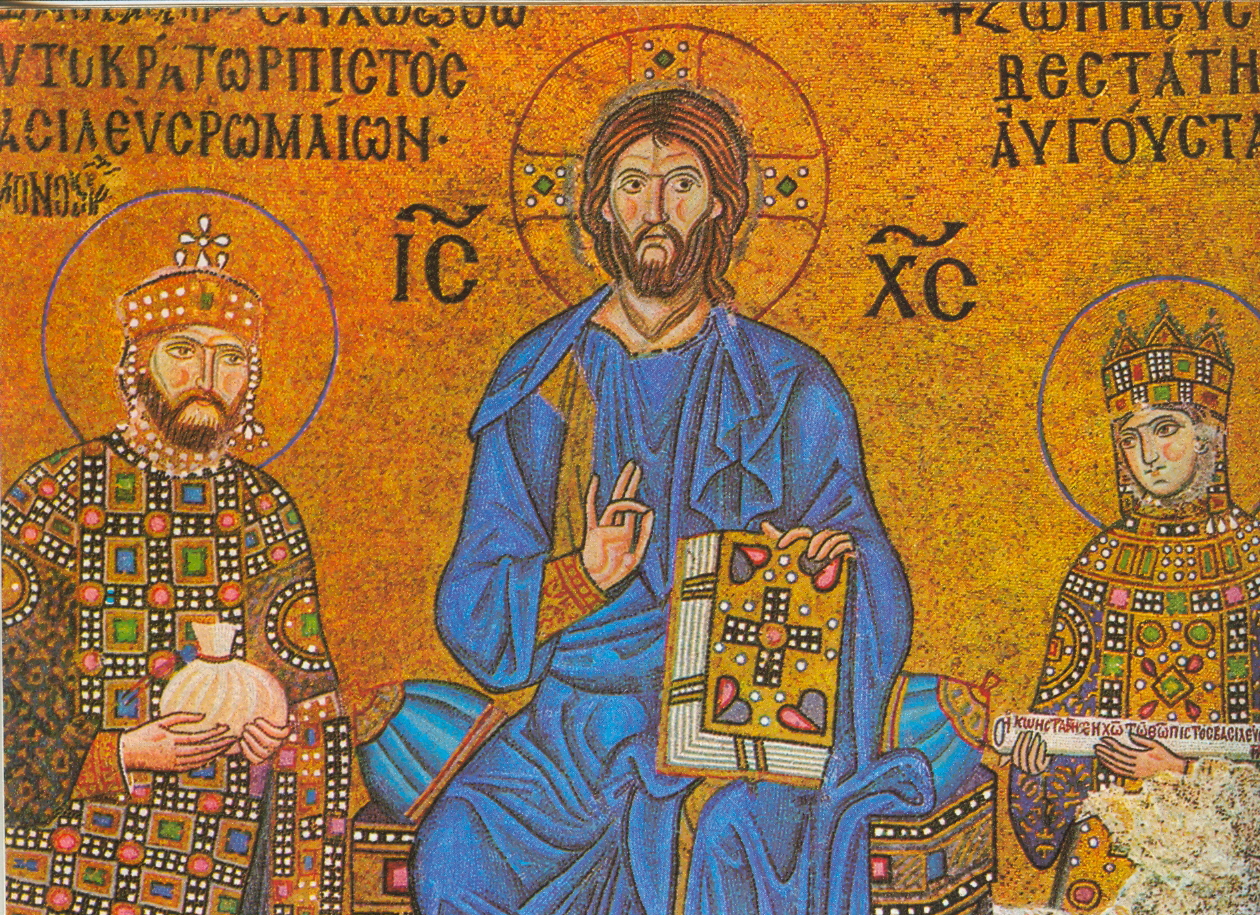
Constantine has at least left us his mosaic portrait (above), in the last bay of the south gallery of Hagia Sophia, the great cathedral church of Constantinople. Zoe was already depicted there, she and her previous husband, Michael, presenting gifts to the figure of Christ. On marrying Constantine she had all three heads renewed, ensuring that her own showed her in the most youthful, flattering light. Constantine’s interpolated head seems more realistic, with his handsome features and the fresh, ruddy complexion to which Psellos refers.
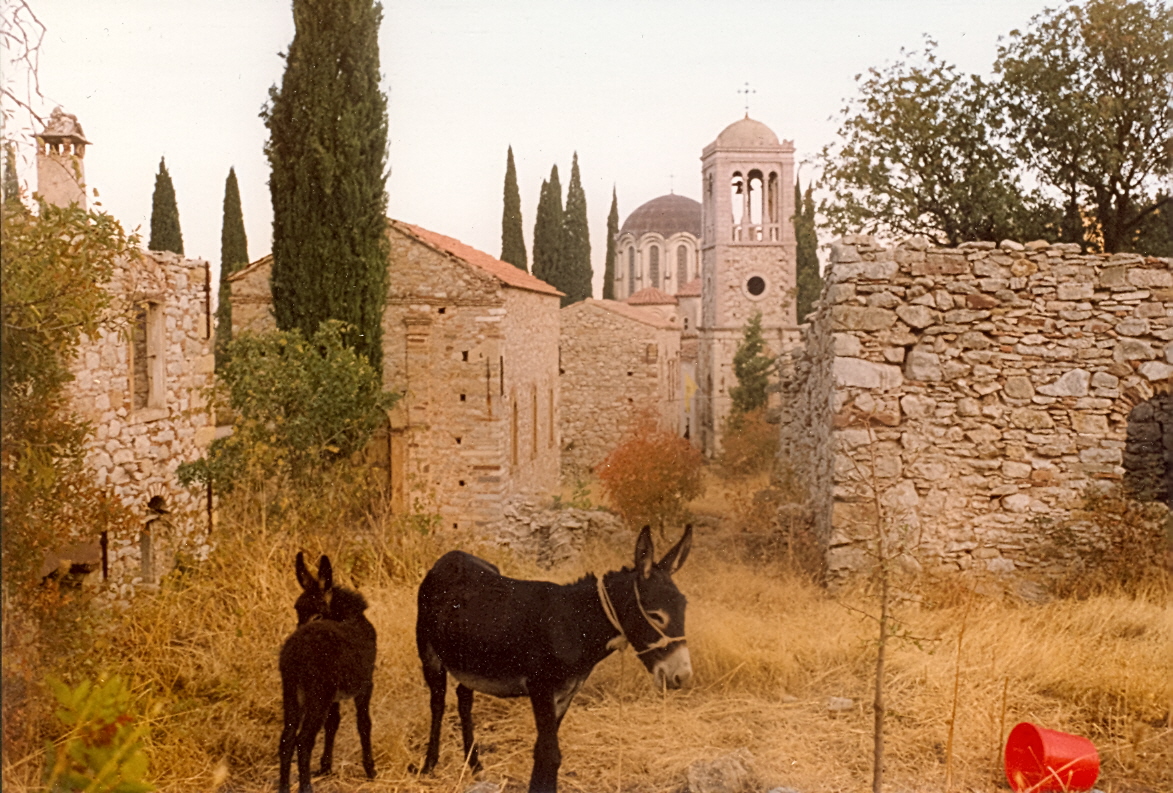
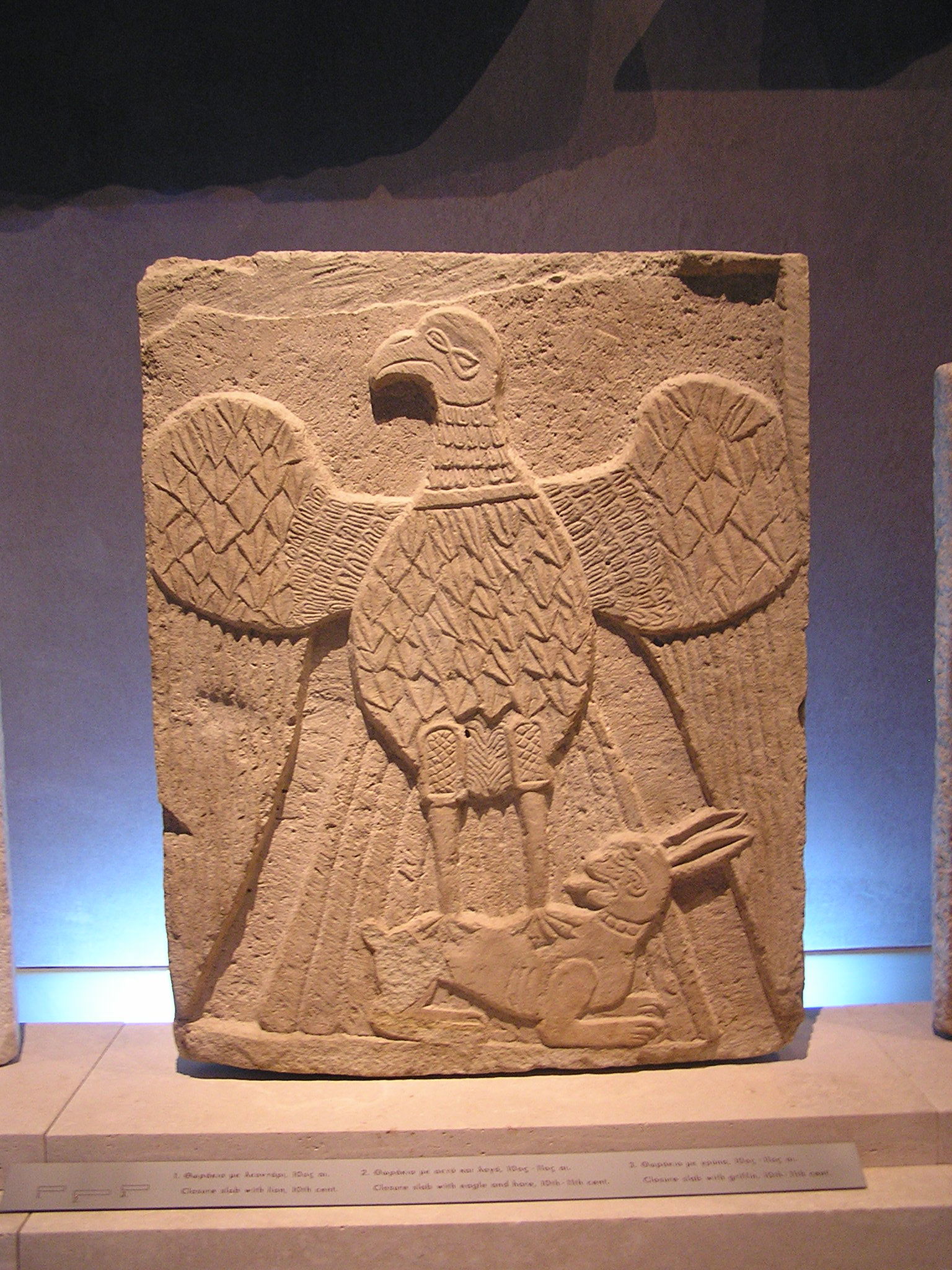
Constantine in gratitude to the Chian monks also founded the Nea Mone (‘New Monastery’) on the island (pictured left). It is now deserted, but I remember on a visit in October 1991 seeing a small psalter or prayer-book that is supposed to have belonged to him. Moreover, there are through Vladimir Monomakh – whose many descendants include Edward II’s queen Isabella of France – countless people in the West who can, with some confidence, claim Constantine IX Monomachos as a kinsman – if not as a direct ancestor.
Simon Raven’s Younger Brother: Myles Raven, the Terror of Tormore School

October 14th, 2011

The famous ‘Desert Boot’ was invented by Nathan Clark, who died on 23 June 2011. According to the obituaries, he was inspired by the rough suede boots, knocked up in the Cairo bazaar, that had been sported by officers of the Eighth Army during the war.

His design was not immediately appreciated by the stuffy directors of his family firm, James Clark and Sons. They ‘felt that there was something louche about suede as footwear. It was for bohemian and essentially unreliable characters.’

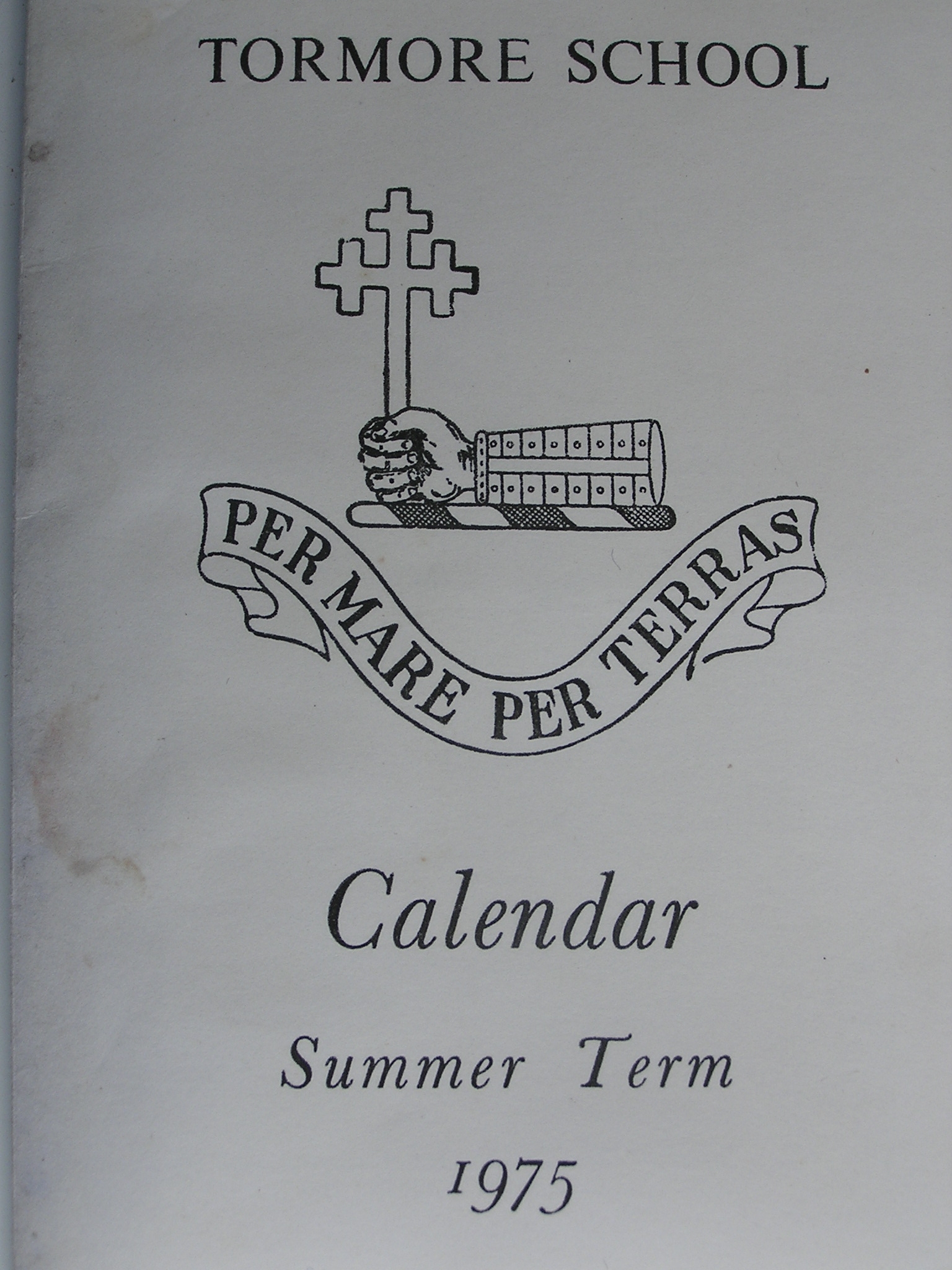
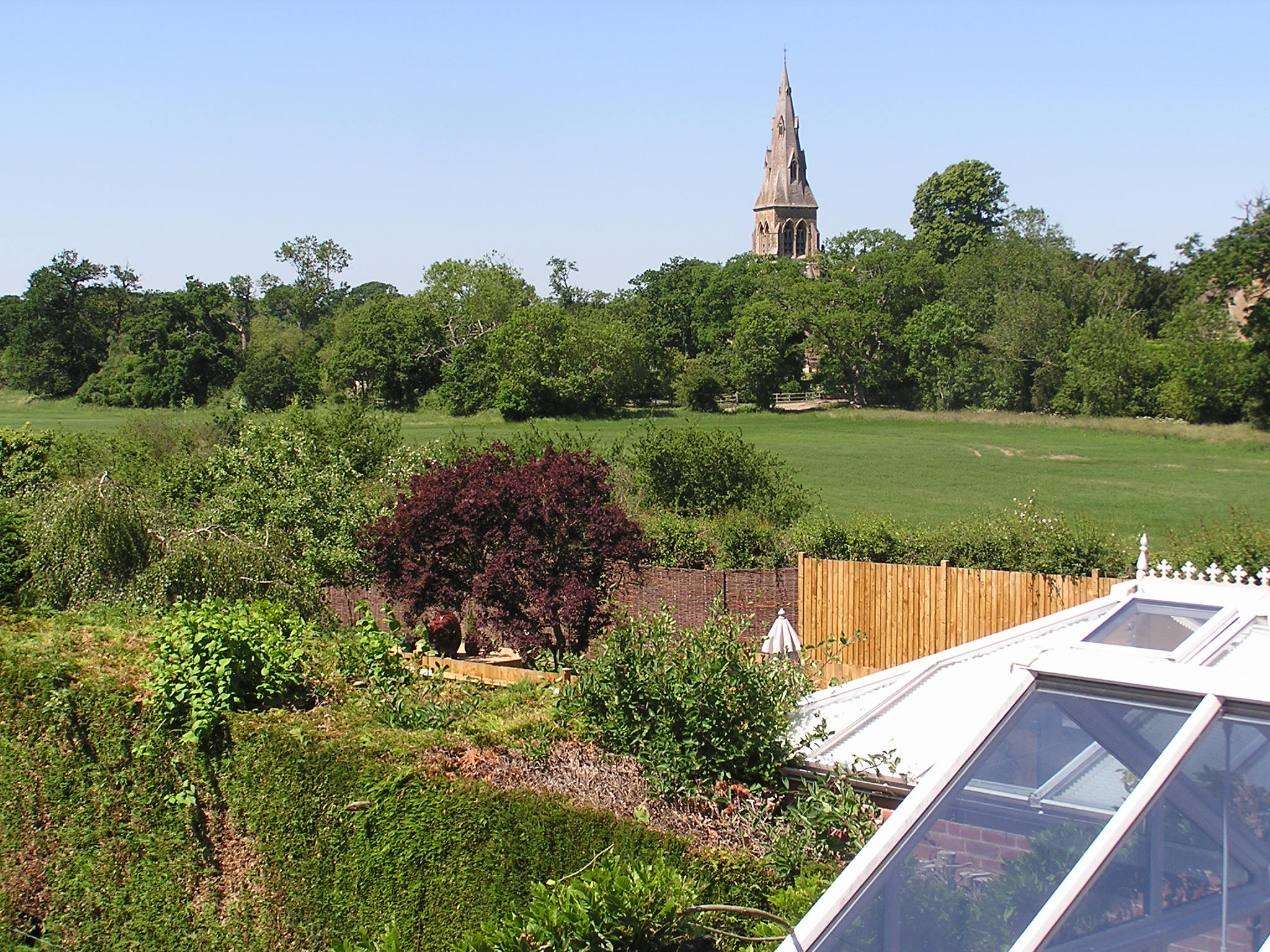
What, then, was one to make of Myles Raven, the legendary Latin and Maths master at Tormore School (my alma mater in Kent), and terror of generations of small boys? Raven, known as ‘Bird’, was reputed to possess forty pairs of suede boots. They lined the skirting board of his bed-sitting-room at the Old House, like soldiers on parade.

It was the horror of having Raven permanently on hand, as much as the lack of plumbing, that made the Old House the most unpopular boarding house at Tormore. As Bird lurched from his room of a morning, to shave from a bowl of boiling water on the landing, one saw far more of his flabby, six-foot-three-inch frame than was palatable. He was quite naked, apart from a white towel that hung precariously from his waist.

If I stole a glance past Raven in the direction of his fetid room, where the curtains seemed to be permanently drawn, it was only to verify the tales I had heard of his suede shoes – he certainly never wore anything else. Raven was dangerously unpredictable. He was prone to terrible, uncontrollable rages, in which his florid face would metamorphose into a livid purple. These were frequently triggered by the failure of individual pupils or an entire form to understand a particular lesson (such as ‘ut’ plus the subjunctive).

As they lined up at his desk to have him mark their work, boy after boy would offer proof of his incomprehension. Bird was like a simmering volcano. Suddenly, he would erupt, scoring his red Bic biro deep into the exercise book of the nearest boy. Others would have their books cast unceremoniously through the open French doors into the garden of the Court House, where they would invariably land in a muddy flower bed or a puddle.

Mercifully, the bell would eventually sound to mark the end of the lesson (potentially a long wait, if it was a ‘double’). Ashen faced, the released boys would alert the incoming form as to what was in store. ‘Birdie’s in a bait,’ they would mutter as they scurried away, leaving the trembling new arrivals to their doom.

A further ordeal was to be placed on Bird’s table at mealtimes. There were about a dozen tables in the school dining room and a further three in the adjacent library, where Bird presided. Each dining set, made up of boys of all ages, would progress weekly between tables, in an anti-clockwise direction. All of us dreaded the three weeks when we would be in the same room as Bird, and particularly the whole week that we would have to spend on his table.

It was particularly distressing to see him devour a substantial cooked breakfast on a daily basis, while we were permanently on short rations. (We were told, unconvincingly, that it was something to do with his diabetes.) He was also prone to revolting coughing fits and, when in one of his moods, was far from pleasant company.

It struck no one as odd that Bird should habitually chain-smoke during his lessons. He was a workmanlike teacher, who believed in learning by rote. Latin tenses and declensions were drummed into us (‘dominus, domine, dominum, domini, domino, domino’; ‘bellum, bellum, bellum, belli, bello, bello’ etc.). I doubt that he found his work rewarding. The hour devoted to ‘prep’ on winter evenings was an unpleasant enough experience, as the form-rooms were unheated. Under Bird’s supervision, it could be considerably worse. Heedless of our discomfort, he would sit outside the 4th Form in his green Sunbeam Rapier, turn the engine on and warm himself by the car’s heater, whilst leaving the door of the form-room wide open so that he could keep an eye on us.

My brother tells another story which illustrates Bird’s remarkable lack of consideration for his charges. The First XI, with my brother as scorer, were conveyed to a fixture at Milner Court in the masters’ cars. It was a pleasant summer’s day and, on the way back, with numerous sweaty boys crammed into the Sunbeam, Bird spotted a stall selling fresh strawberries in a lay-by (my brother passed the spot recently and recognised it at once – it is between Howe Barracks and Littlebourne). Bird hauled himself out of the car, bought two punnets, and proceeded to consume the entire contents in front of the ravenous boys.

Bird’s antics have made more sense to me since I read Michael Barber’s book The Captain, a frank and entertaining biography of his elder brother, the writer Simon Raven. An extravagant, amoral hedonist, sacked from Charterhouse and the army (he had served in Kenya as a Captain in the King’s Own Shropshire Light Infantry), a distracted Simon had been exiled to Deal by his publisher (‘Leave London, or leave my employ’). In my day, he lived in a tiny clapboard cottage across the road from the ‘Admiral Keppel’, which was conveniently positioned only a few doors down from the Old House.

The Raven brothers were both avowed homosexuals, yet Myles had once been engaged – to one of the under-matrons – and Simon had been briefly married. According to Barber, an anguished telegram from his abandoned wife – ‘WIFE AND BABY STARVING SEND MONEY SOONEST’ – had prompted a characteristic reply – ‘SORRY NO MONEY SUGGEST EAT BABY’. His reputation at Tormore was as the author of ‘dirty books’, which some boys’ fathers had read. Shortly after leaving Tormore I read one myself and it was, indeed, utterly filthy. (A typical line of dialogue, from a colonel addressing his mess: ‘I’ve f*****d women from every continent and most animals, but I’ve never had a woman like that!’) I remember the boys of my house, ‘Tanks’, being taken on a school treat to the cinema at Deal, to see On Her Majesty’s Secret Service. Michael Webb briefed us beforehand that all the wittiest lines in the film had been written by Simon, whose name duly flashed up on the screen. Simon also scripted The Pallisers and Edward and Mrs Simpson for television, but it was only after the publication of The Roses of Picardie in 1980 that I became aware of his literary eminence.

The occasional sighting of the caddish Simon caused a certain frisson – usually striding past the school, clad like his brother in a tweed jacket and desert boots, with the same snub nose, prominent eyebrows and florid complexion and the furtive look of a mischievous faun. I have no recollection of ever seeing him on school premises, and wonder if he had been banned (as he was from the Royal St George’s Golf Club). However, my brother assures me that he came into the school regularly to watch our cricket matches, and at one time he wrote witty reviews of them for The School Record.

Simon used to hold court at the ‘Admiral Keppel’, where most of the masters seemed to spend their evenings. Worldy, erudite and amusing, he was, I believe, a strong and, in many ways, beneficial influence on the younger staff, men like Michael Webb and Michael Strevens. I suspect they picked up many of their odder expressions and ideas from him, including – I rather fear – their habit of referring to us boys by rather surprising terms of endearment, including ‘dear heart’ and ‘duckie’.

According to Strevens – the dashing, aloof ‘Strev’ – Myles would consume four or five pints between nine o’clock and closing time and then would stagger home with a further four pints in a jug. He is said to have suffered from appalling flatulence and smelly feet, and also, occasionally, to have wet his bed, but was immune to any form of hangover. He also never wore underpants, a legacy of his own, very peculiar prep school, where they were banned. I have a feeling that we were aware of this surprising detail at the time, but shudder to think how we can have known it. One instinctively shunned him as one would an electric eel. However, I never heard of him touching any boy. Strevens told Barber that Bird had once made a botched attempt at doing so. It had been a humiliating experience and was never repeated.

Myles Raven, described by a school contemporary as ‘the idlest Scholar elected to Charterhouse in living recollection’, must have been frustrated in many ways, but schoolmastering made few demands on him and gave him limitless opportunites to indulge his obsession with cricket, not to mention his illicit fantasies about little boys. I have a vivid memory of his enquiring of us, in a Latin lesson, what part of speech ‘Eheu’ was. No one knew. ‘It’s an ejaculation!’ he said, with relish. He seemed distinctly out of place on his rare trips to London – ‘a big lump who smelt strongly of pubs’, according to one of Simon’s smarter friends. He fell down dead in 1976, at the age of 46.

Read further memories of Tormore: http://www.rupertwilloughby.co.uk/archives/673

Readers comments are extremely welcome. The Administrator apologises if any recent comments have not been published. This is because of his reluctance to sift through the weight of spam that he receives daily through the website! In future, please email your comments to RupertWilloughby@btinternet.com.

Jeremy Irons in ‘The Kingdom of Heaven’ and ‘The Borgias’ – and Some Tips for Handling Women

August 27th, 2011

I am a great admirer of Jeremy Irons. He appears, as the fictional Raymond, Count of Tiberias, in one of my favourite films, Ridley Scott’s Kingdom of Heaven. I had much enjoyed being directed by Ridley in his previous film, Gladiator, but hated his Kingdom when I first saw it, put off by the neo-Communist tendencies of the hero. It was hardly credible that Balian of Ibelin would have preferred the life of a common blacksmith to that of an opulent, if beleaguered, lord of Outremer. However, the film is an amazing spectacle, which seems to capture both the look and the spirit of twelfth-century Palestine.

Jeremy Irons delivers a typically magnetic performance. Regrettably, he has since been hopelessly mis-cast as Pope Alexander VI in Sky Atlantic’s current series The Borgias, from which it appears that the scandalous pope and all his family led remarkably dull lives.

Off screen, Irons has a pleasingly elegant and insouciant manner, and a tendency to be ‘tactile’ with women that occasionally lands him in trouble. In an interview with the Radio Times, he maintains that for a man to put a hand on a woman’s bottom is a form of ‘friendly communication’, with which any woman worth her salt ought to be able to deal.

This month (9 August), he has been pictured in the Daily Telegraph in an encounter with someone called Sienna Miller. He rests his hand on her shapely hip, whilst gazing admiringly at her cleavage. She seems not to mind, but one must accept that such behaviour is not generally tolerated. This sort of gesture may pass ‘in thespian environs as a camp affectation,’ writes the Telegraph columnist, Hannah Betts. ‘In the real world, though, it is regarded less as “communication” than sexual assault.’ What it communicates to Miss Betts is the message that Irons is a ‘tragic soon-to-be pensioner having a belated mid-life crisis’. (See http://fashion.telegraph.co.uk/beauty/news-features/TMG8691481/Time-that-men-such-as-Jeremy-Irons-got-a-bum-steer.html.)

Irons floats a rather more interesting idea in his interview with the Radio Times, in which he admits to having ‘a salacious private life, which I hope most people have. We only live once.’ It is as well for me that Pope Alexander enjoyed a notably salacious private life, as I myself am the fruit of his loins, directly descended from his son Cesare. (See Patrick van Kerrebrouck, La Maison de Bourbon, 1256 – 2004, IV (Villeneuve d’Ascq, 2004), pp.789-96; Rupert Willoughby, ‘Cesare Borgia – his Marriage and his Descendants’, in John Campbell-Kease ed., Tribute to an Armorist: Essays for John Brooke-Little to mark the Golden Jubilee of the Coat of Arms (London, 2000), pp.102-16.) In the first episode, when the newly-elected Alexander mounts the famous hollow throne to have the said loins inspected – thereby ruling out the embarrassment of another Pope Joan – and is declared to have ‘duos testiculos, et bene pendentes’, I found myself positively glowing with pride. I shall therefore follow the series with familial interest, if only for the inevitable re-enactment of the notorious ‘chestnut orgy’.

Meanwhile, I should like to propose that Mr Irons try the following approach with women. It is harmless, and may prove more effective.

You should solemnly kiss the woman’s hand, then ask to kiss the other one too. You should then say something along the lines of: ‘Not only are you the kindest and most amenable woman in the world, but you are grace personified, and they should build temples of white marble to you in groves of myrtle. I am very much afraid that what happened to Psyche may happen to you as well, and that Venus will become jealous of you.’

At this point, join the two hands together and press them both to your lips. You may be asked whether you have learned such fine phrases by heart, in which case you must quickly say: ‘Not at all. You are certainly worth turning a fine phrase for, and lovely enough to have lyrics specially composed in your honour’ etc. etc. (After Théophile Gautier, Mademoiselle de Maupin (Paris, 1835), Chapter VII – the supreme Romantic novel.)

Michael Keroularios, Patriarch of Constantinople, Michael Psellos, Consul of the Philosophers, and their ‘Niece’, Eudokia Makrembolitissa

August 15th, 2011

Michael I Keroularios was appointed the Ecumenical Patriarch of Constantinople in 1043, during the reign of the Emperor Constantine IX Monomachos. He is a great figure in the history of the Orthodox Church.

The Emperor Monomachos was keen to ally himself with the Papacy against the Normans, who had overrun his possessions in southern Italy. Unfortunately, the reformed church in the West was now insisting (unhistorically) on the effective primacy of the Pope of Rome, and his entitlement to enforce religious discipline and conformity over the whole of Christendom.

Among other differences, the Westerners fasted on the Sabbath, ate strangled meat and, above all, used unleavened bread, or ‘azymes’, in the Sacrament. These customs accorded with Judaical law, but not with the tradition of the early church, which considered itself to be under a new dispensation. The reformed Papacy was nevertheless determined to impose discipline and ‘correct’ practice throughout Christendom. Keroularios rightly suspected that the alliance would come at a heavy price, and was having none of it.

In 1054, he had an ill-tempered encounter with a distinguished papal delegation, which accused him of disobedience towards the Pope. Keroularios deliberately took no notice of them. As a result, the exasperated legates handed the disdainful Patriarch a bull of excommunication in the middle of a service in Hagia Sophia. Having stormed out of the cathedral, they theatrically shook the dust from their feet. Keroularios responded to this insult in kind, with the full support of the city, and the legates were obliged for their safety to hurry home.

Each side had been careful to direct its excommunications at a small number of individuals; and to represent the affair as marking the final schism between the two churches is a fallacy. It was, however, a landmark in the process of estrangement, when each side was fully and disturbingly exposed to the prejudices and claims of the other.

For the proud Byzantines, it was bad enough to be lectured by ‘heretics’ (the Westerners had tampered with the Nicene Creed by inserting the word ‘Filioque’). It was worse still when they were ‘barbarians’. The legates had addressed a wildly inaccurate tirade against Keroularios, who, in a lofty reply, described them as ‘men who had burst from the evening shadows of the West’ and ‘attacked like some wild boar’. Constantinople, he wrote, was ‘God’s protected city, whence the springs of orthodoxy, the pure waters of the true faith, will flow like streams from a mountain peak to water all corners of the Earth and quench the souls of all men with the divine teachings’. (See Will ed., Acta et Scripta de Controversiis Ecclesiae Graecae et Latinae; Steven Runciman, The Eastern Schism.)

Keroularios was not happy when, after the death of Monomachos in 1055, his sister-in-law, the porphyrogennete (‘purple-born’) Empress Theodora, sought to reign alone. Once friendly, she now ‘abominated the man, refusing even to meet him. There was a reason for this: the Patriarch was vexed because the Roman Empire was being governed by a woman. Characteristically he was filled with wrath at this state of affairs, and he spoke his mind freely.’ (Michael Psellos, Chronographia, VI, xviii, trans. Sewter, p.269.) He was no happier with her successor in 1056, the near-senile Michael VI – a mere puppet of the court eunuchs – and helped, by inciting a riot in the city, to engineer his deposition in 1057.

The habitually forthright Keroularios soon quarrelled with the new Emperor, Isaac I Komnenos. Having presented him with the throne, he felt entitled to share in his imperial power and, again, used ‘language that was somewhat bold’. He is said also to have sported a pair of purple buskins, an act of treason, as purple garments were traditionally a prerogative of the Emperor. However, he had met his match in Isaac, a tough general with a no-nonsense approach.

In November 1058, Isaac arrested the troublesome Keroularios and exiled him to Prokonnesos, thus ‘casting the Patriarch off as if he were a load off his shoulders’. (Psellos, Chronographia, VII, 65, trans. Sewter, p.315; Skylitzes, 809, p.644.) Michael Psellos, a trained lawyer as well as ‘Consul of the Philosophers’ in the University founded by Monomachos, was instructed to prosecute him. Psellos’s detailed Accusation sets out the charges both of heresy and treason. However, Keroularios died unexpectedly, before coming to trial. Psellos says that the usually dour Isaac ‘bewailed his loss loudly and mourned him sincerely’, and – guilty at having brought down so great a personage – immediately rehabilitated his family at court.

These included the Patriarch’s niece, Eudokia Makrembolitissa, second wife of the vestarches Constantine Doukas, a nobleman from Paphlagonia. Eudokia was the daughter, by the Patriarch’s sister, of Ioannes Makrembolites, and according to Psellos was ‘a woman of great spirit, and exceptional beauty’. Interestingly, Psellos describes himself as Eudokia’s ‘uncle’ and, elsewhere, as ‘spiritual brother’ to her father, who was presumably his first cousin. Psellos was thus related by marriage, if not by blood, to the Patriarch. (D.I. Polemis, The Doukai (London, 1968), pp.28-34; K. Barzos, Ή Γενεαλογια των Κομνηνων (Thessalonica, 1984), I, p.125; Jean-Claude Cheynet, Pouvoir et contestations à Byzance (Paris, 1996), p.275.)

In the autumn of 1059, a disheartened Isaac himself became ill. Psellos, a proficient doctor among his other skills, convinced him (wrongly) that he was dying. That November, Isaac was persuaded to abdicate in favour of their mutual friend and relative, the amiable Constantine Doukas. The new Emperor entrusted the helm of state to Psellos, his wife’s uncle, who claims that Constantine drank his every word ‘like nectar’. The first duty of his former accuser was to pronounce, in the imperial presence, a glowing funeral oration, somewhat overdue, in honour of the dead Patriarch. An unashamed pen-for-hire and political survivor, Psellos now made him out to be a saint.

It is ironic that after the death of the Emperor Doukas in 1067, his widow Eudokia, niece of the misogynistic Patriarch Keroularios, should herself have assumed sole power, even sidelining her ‘uncle’ Psellos, until practical considerations forced her, in January 1068, to marry again. Her new husband, Romanos Diogenes, was the emperor who was defeated and captured by the Turks at the Battle of Manzikert. Psellos loathed Diogenes and, on his release from captivity in 1072, had him savagely blinded, an act of calculated brutality that horrified contemporaries. It enabled Psellos to resume his controlling influence in the court as chief minister to Eudokia’s son, the feeble Michael VII.

Psellos claims in his funeral oration that the Keroularioi were descended from Herakles. They had been patricians at least since the late 10th century, when a Keroularios served as a general (Cheynet, p.52, n.2), yet the family name means ‘candle-maker’. Their earlier ancestors were surely guildsmen in Constantinople, practising their craft in the hallowed environs over which Michael himself later presided. The many churches of Constantinople were, of course, vast consumers of candles.

The Pselloi were also a noble family. Their name, meaning ‘stammerer’, is most inappropriate for their most famous member, who was so renowned as an orator and conversationalist. Psellos reveals the little that is known about his immediate family in an earlier funeral oration that he had composed for his young daughter, Styliane Psellaina. She was his only child after many years of marriage, possibly to a woman called Theodote. (In desperation they had already adopted another girl, Euphemia.) In the summer of 1054, whilst Keroularios was smarting over the insults of the Papacy, Constantinople was in the grip of a smallbox epidemic, mentioned by the chronicler Skylitzes. The 9-year-old Styliane succumbed to the disease and died after 31 days of suffering.

Psellos clearly adored her and was heart-broken. He likens her to ‘a young, soft, tiny bird’. He delighted in her love of learning, in pursuit of which she would voluntarily visit school, presumably to sit at the back while the boys had their lessons; and speaks of her natural talents for weaving and embroidery. Skilled doctor that he was, he describes her illness in clinical detail; also the washing, dressing and laying out of her dead body, reduced to ‘one single open wound’. His later oration to Keroularios seems cold by comparison. (Panagiotis A. Agapitos, ‘Public and Private Death in Psellos: Maria Skleraina and Styliane Psellaina’, Byzantinische Zeitschrift, 101, ii (2008), pp.555-607.) It is the ‘private’ death that brings out Psellos’s innate humanity, and yet, if one thinks of him at all, it is probably not as the victim of a personal tragedy.

What lines of descent can be traced from these families to the present day? Hundreds of thousands, even millions of living people in the West can prove Byzantine ancestry from the eleventh century, through families such as the Komnenoi. Far fewer people, however, are able to establish a link with Psellos and Keroularios.

The Emperor Doukas had by their niece, Eudokia Makrembolitissa, a daughter, Zoe porphyrogennete. She married Adrian Komnenos, brother of the Emperor Alexios I. Their granddaughter, Anna Komnene Doukaina, married Alexios Palaiologos, a member of the last reigning dynasty in Byzantium.

This couple’s great-granddaughter, Theodora Palaiologina, married her third cousin, Andronikos Palaiologos, who died in 1247. They were the parents of the Emperor Michael VII Palaiologos (1259-82), from whom an exclusive number of Western families are able to trace their descent. I myself have a double descent from Michael.

In 1355, Michael’s great-great-granddaughter Maria was given in marriage by her brother, the Emperor John V, to Francesco Gattilusio, a Genoese buccaneer in his service, whom he made lord of Mytilene or the island of Lesbos. (D.M. Nicol, The Last Centuries of Byzantium (Cambridge, 1972), p.256.) Their granddaughter, Catarina Gattilusio, married Pietro di Grimaldi, Baron of Bueil. Thence the line is traced directly, through thirteen generations, to my French great-grandmother. It is thrilling to think that I am flesh and blood with the likes of Psellos and Keroularios, and, indeed, one of their nearest living relatives.

A Day at the Dig, Part II: Further Discoveries at Roman Silchester

August 11th, 2011

The second ‘open day’ at Roman Silchester on Saturday (6 August) was as festive as the previous one. It was attended by many hundreds of visitors of all ages. Most were locals, but others had travelled great distances, including a couple from Northamptonshire, such is the fame of the event.

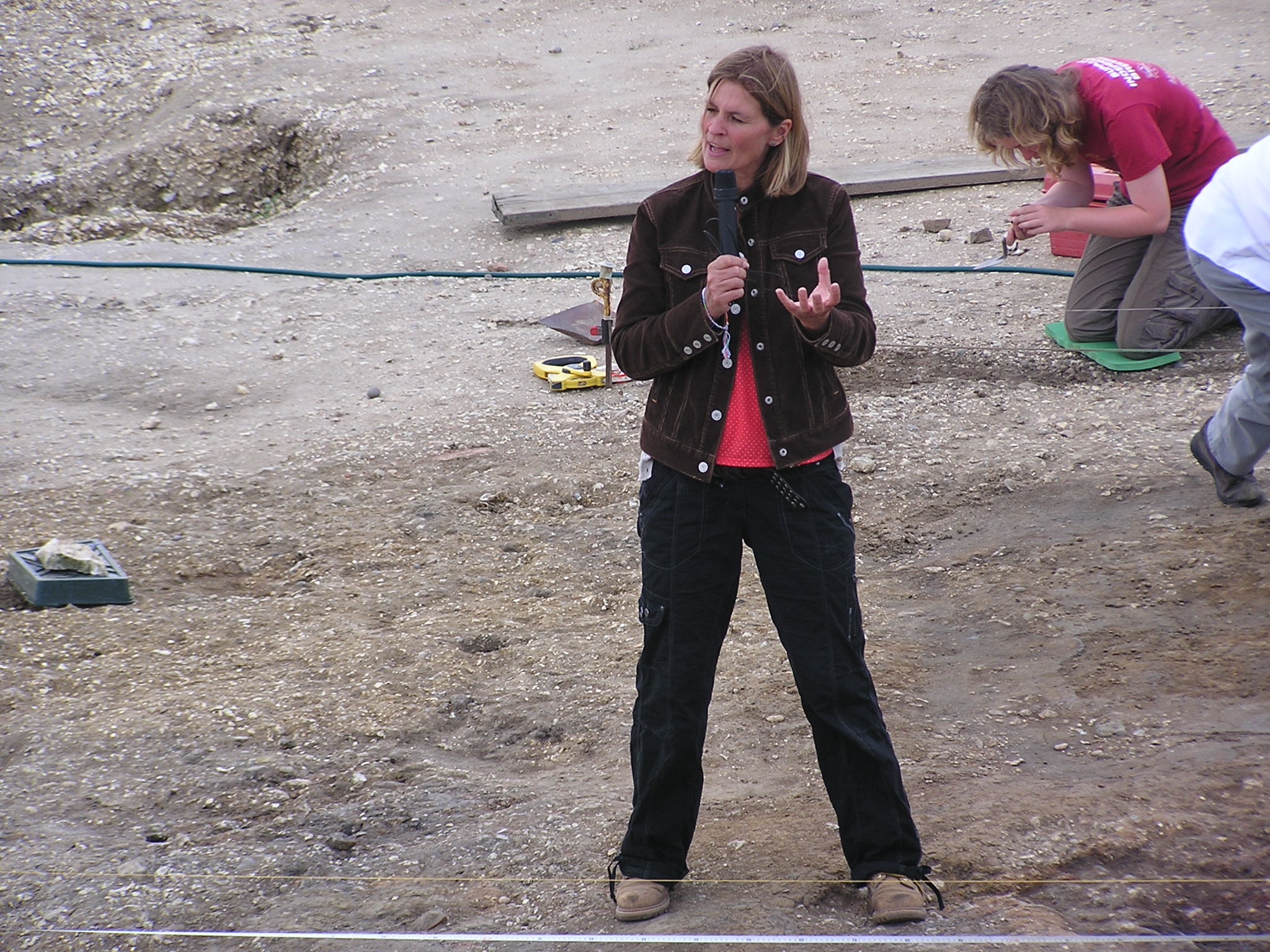
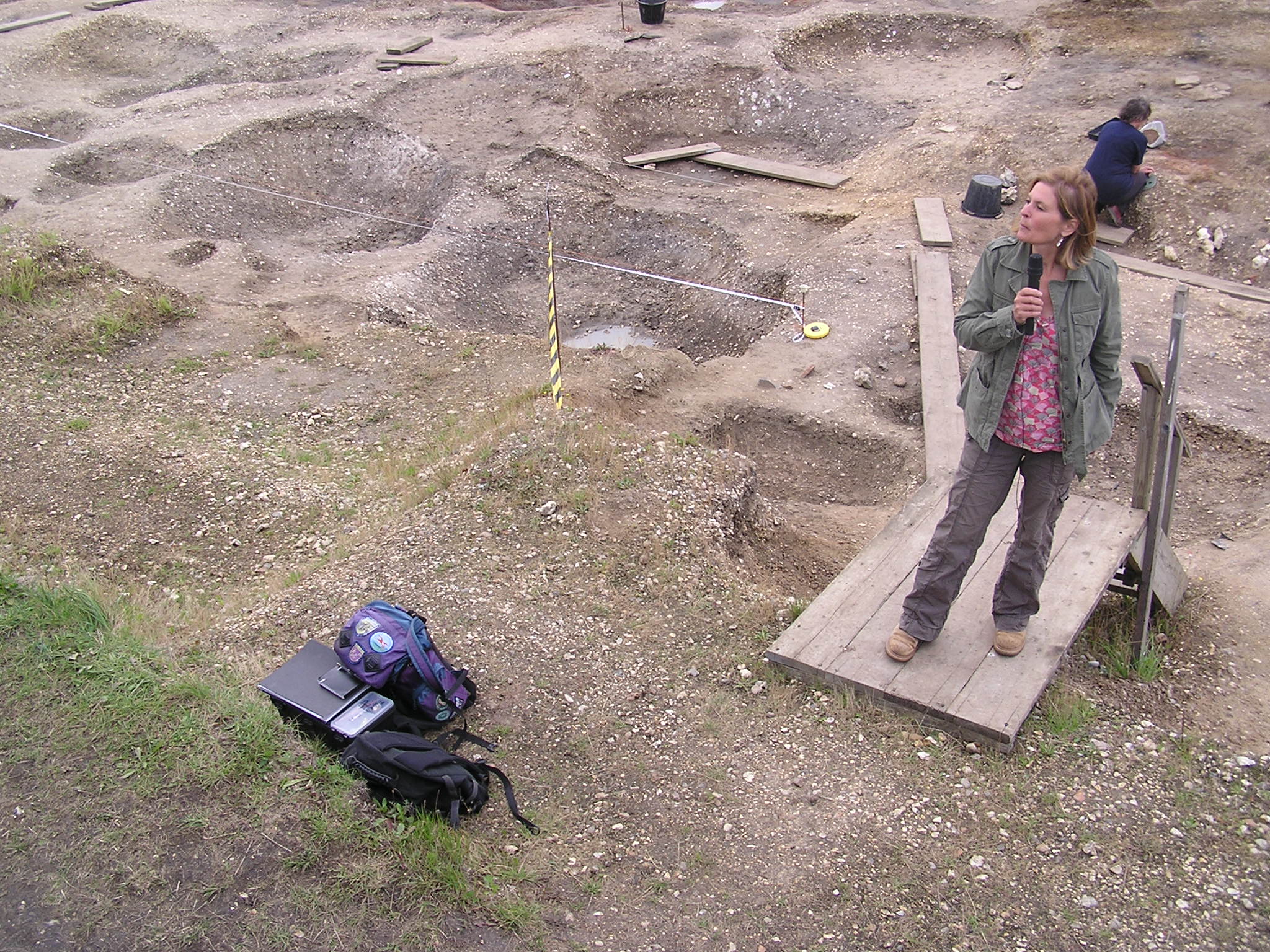
Professor Michael Fulford and Amanda Clarke took turns to deliver hour-long guided tours. Deftly brandishing her microphone as if she were presenting X-Factor, Amanda brought us up to date with the latest discoveries. We were encouraged to look upon the dusty contours of the site with ‘archaeologists eyes’. She pointed to the remains of the first-century roadway that cut across a corner of Insula IX. Its orientation, apparently based on the rising and setting of the sun, would have been irksome to the Romans, who later imposed their preferred grid system on the town.

The early road was flanked on one side by a wooden palisade, with a ditch beyond it. On the other side, there were rubbish dumps and ‘natural geology’, as if it were on the very edge of town. One of the houses on this street was of high status (though wooden), and the owners had buried their little dog, perhaps a terrier, near one of the corners of the building. These people are said to have eaten fancy food off imported tableware.

A still more arresting discovery has been that of a latrine on the opposite side of the road, which will tell us all about their diet. This latrine is narrow enough to have been equipped with a wooden seat – all of which leads Amanda to believe that the indigenous population were far from being the ‘grunting savages’ of legend. (She admits that the expression ‘beautiful latrine’ is unlikely to be uttered by anyone other than an archaeologist.) Presumably, though, the urban population of Silchester were not typical of Britain as a whole. In any case, were not the Atrebates tribe themselves recent immigrants from the Continent?

On the subject of the ubiquitous latrines, they have discovered that a later well was carelessly sunk over the remains of one. Poisoned water from such ill-positioned wells may explain the abandonment of the city in the fifth century. Amanda will have the winter months in which to ponder the significance of such data.

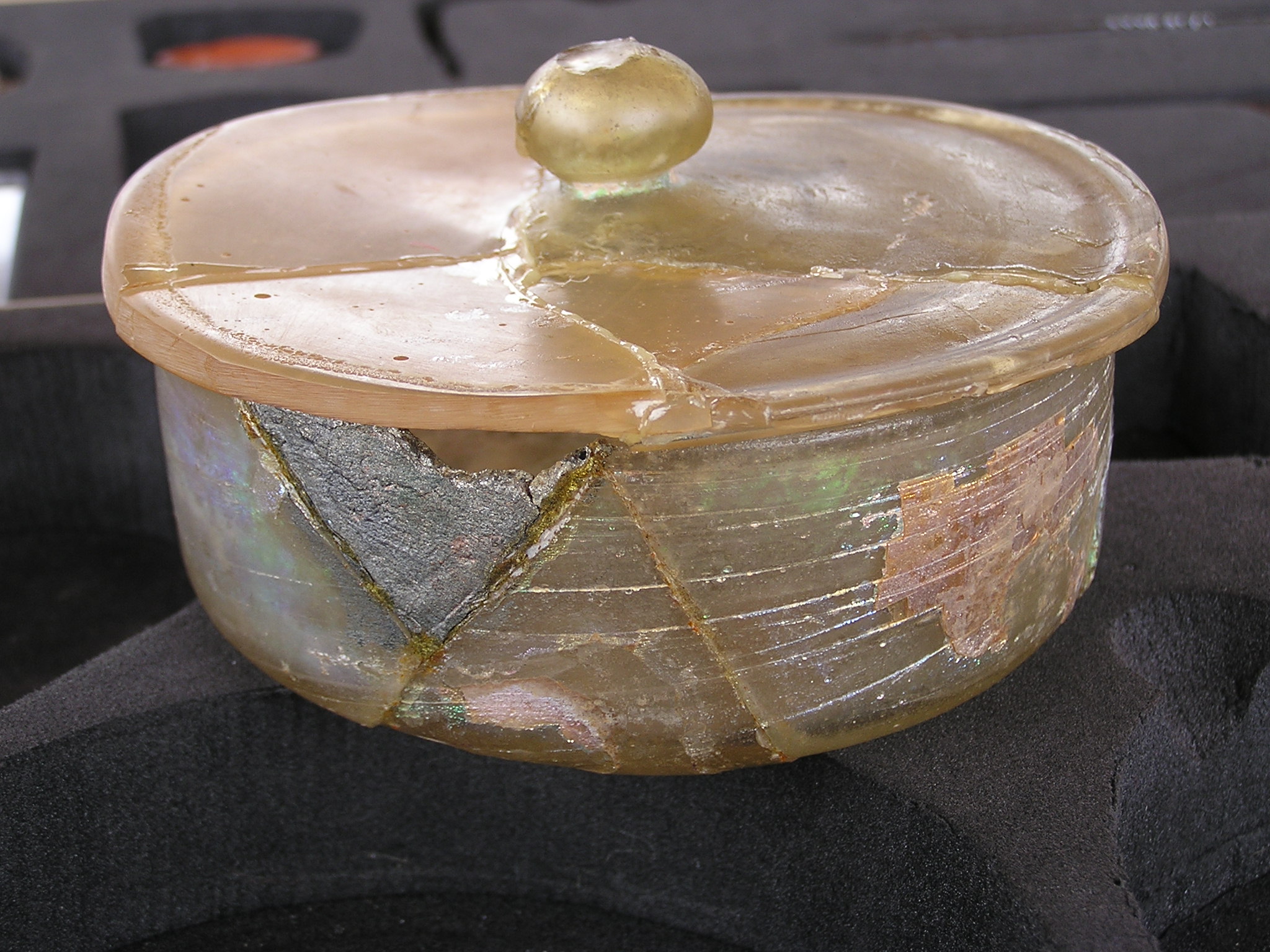
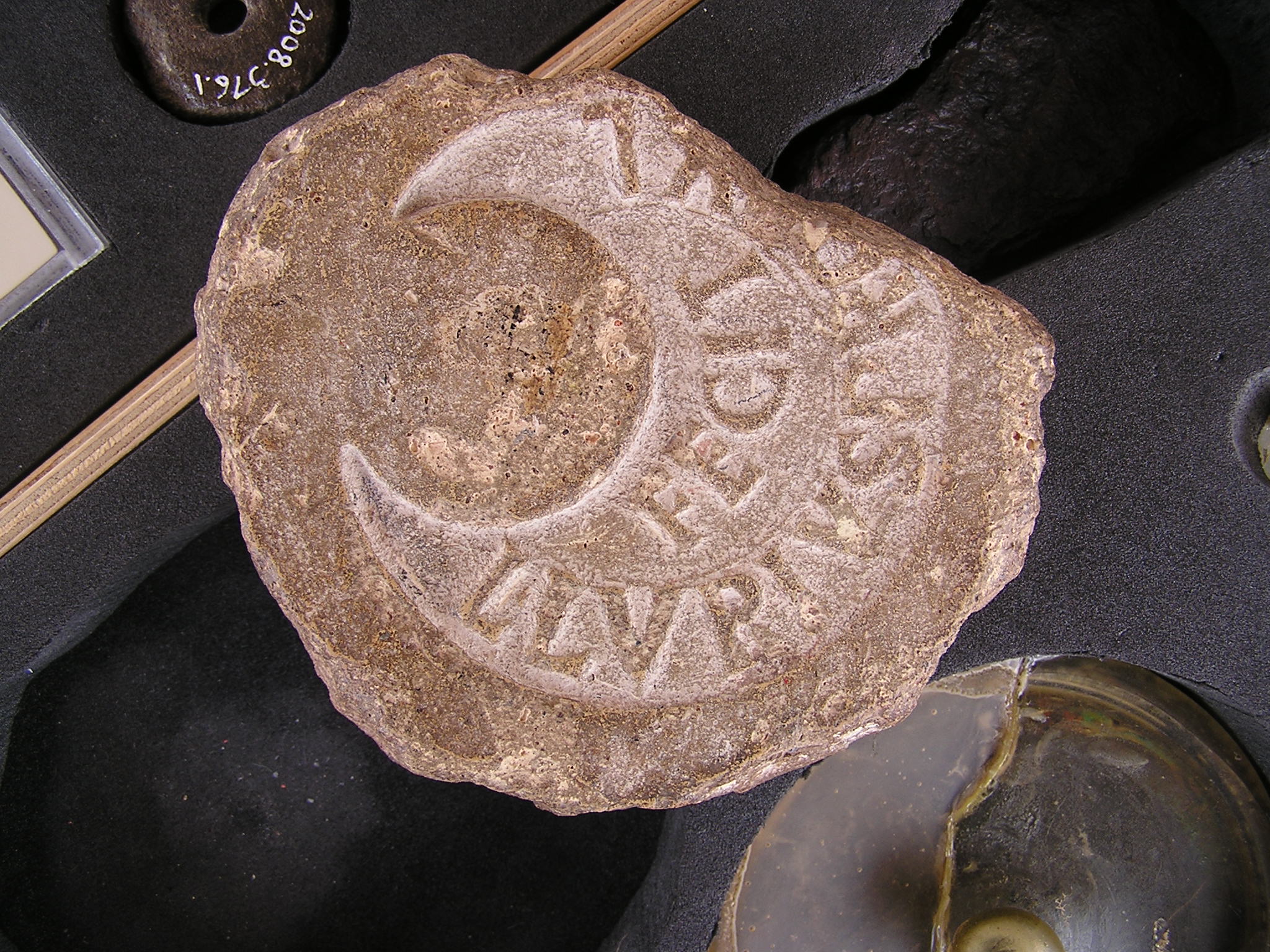
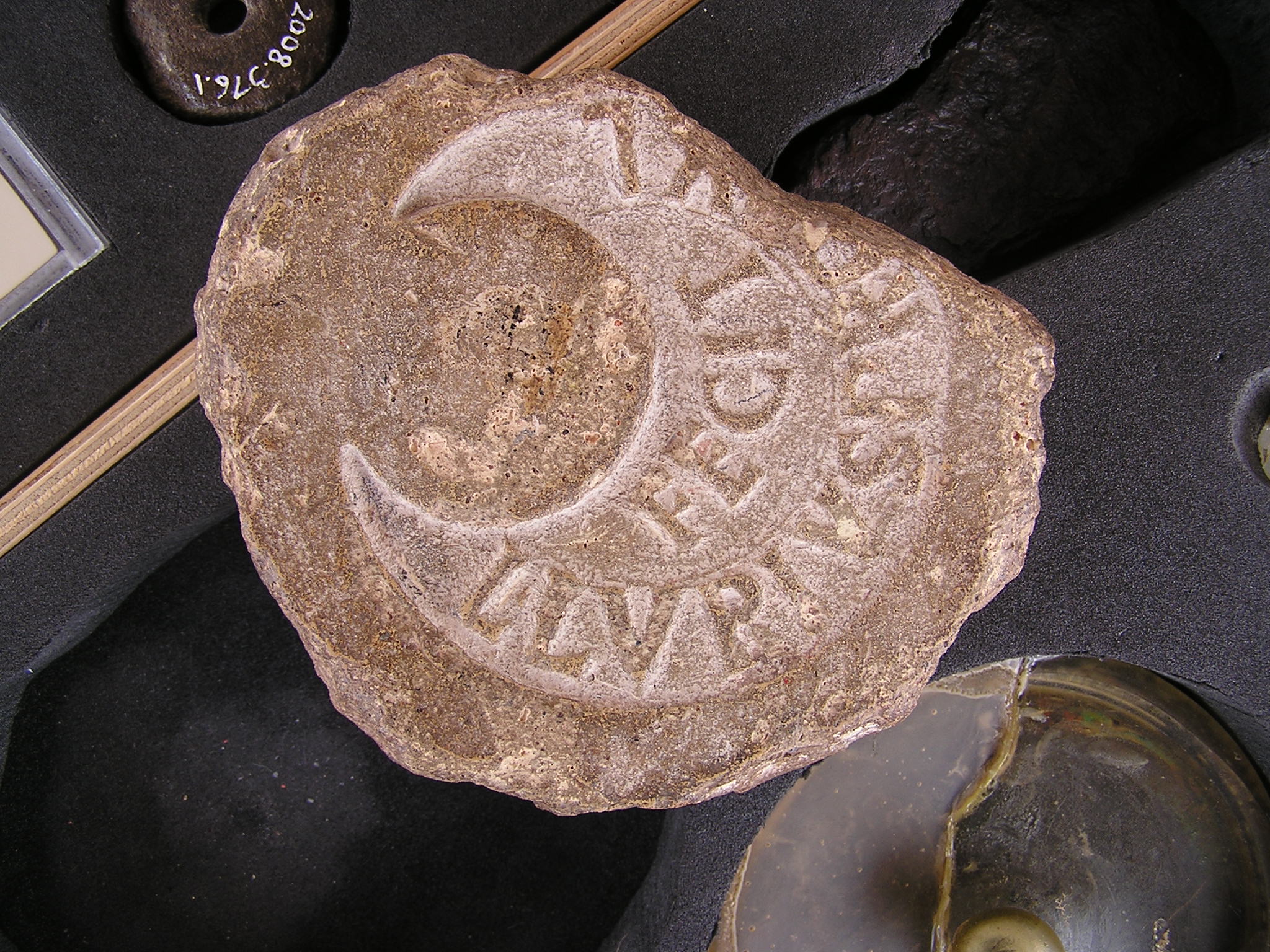
On the Reading Museum stall, visitors were invited to handle some of the fruits of the Victorian and Edwardian excavations, of which they are the custodians. These included a delicate needle, looking as good as new, and a hair-pin from one of the Museum’s loans boxes, which are available for hire by schools and other organisations. The choicest artefacts on display were perhaps this glass jar – almost mother-of-pearl in its opacity – which was an import from the region of Haifa; and this unexplained round tile inscribed with the tiler’s stamp – LLVRIVSPRO-VL FECIT (Lucius Lurius Pro[c]ul[us] made this).

The bronze eagle on which Rosemary Sutcliff based her novel, The Eagle of the Ninth – recently filmed as The Eagle – is on permanent display in the Museum’s Silchester Gallery, along with further curious examples of the tiler’s art.

A Day at the Dig: The Roman Town Life Project at Silchester, Hants.

July 24th, 2011

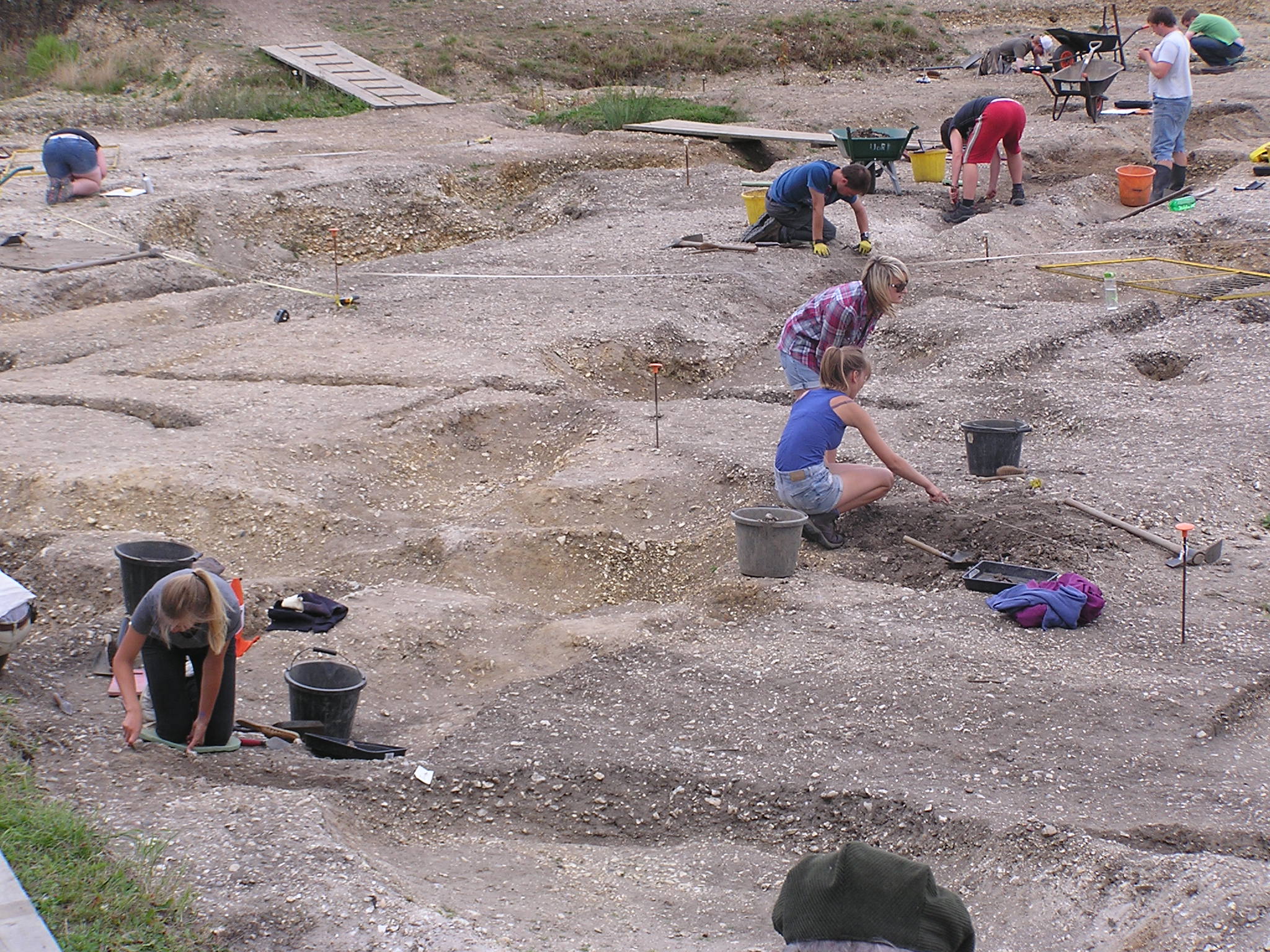
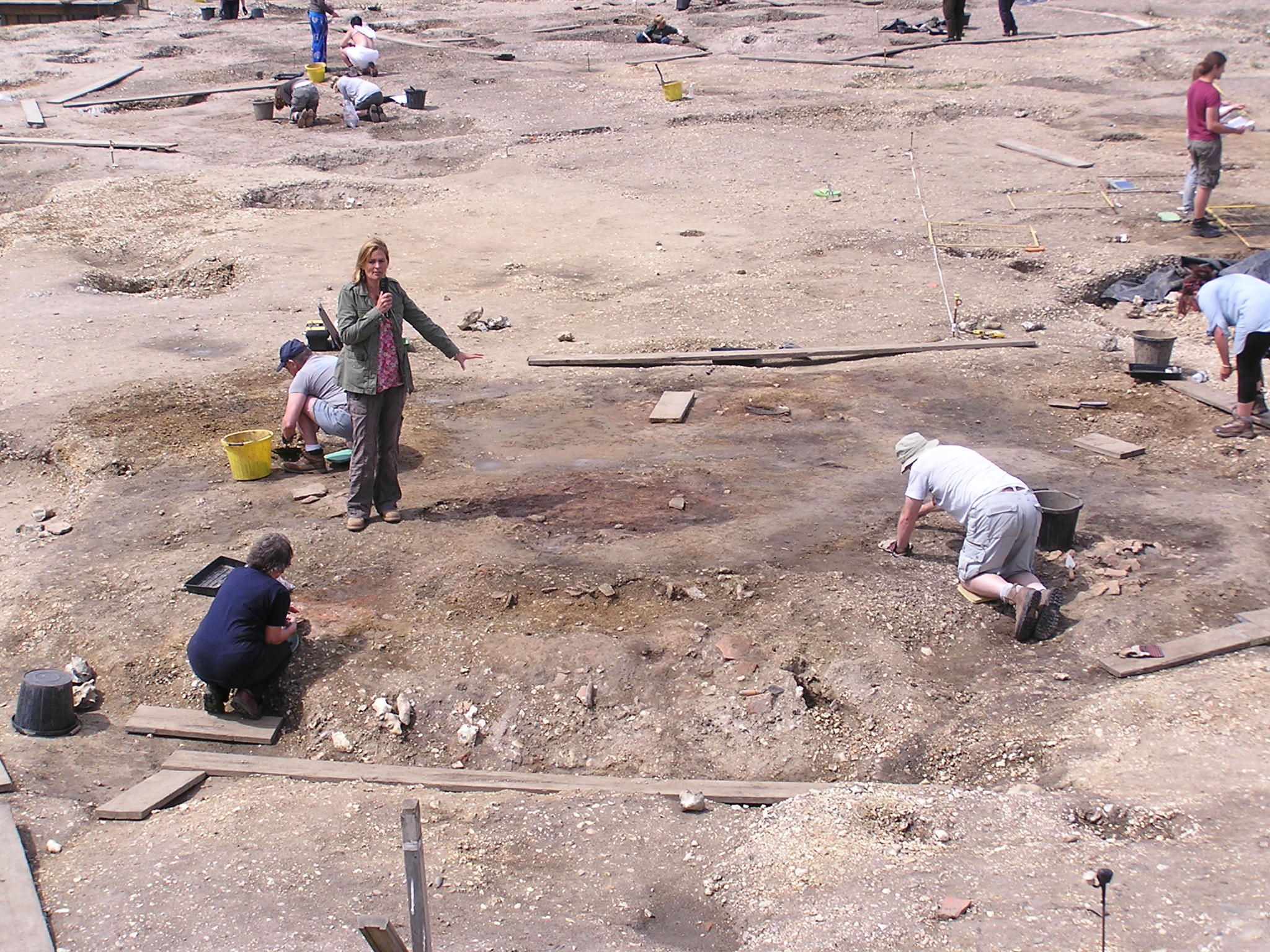
Yesterday’s ‘Open Day’ at Silchester, or Calleva Atrebatum to the Romans, was a typically jolly event. Hosted by the University of Reading’s Department of Archaeology, it was an opportunity to view, at close quarters, what is currently the largest archaeological excavation in Britain.

Now in its fifteenth season, the ‘Town Life’ project focuses on a small part of the 170-acre site, the so-called ‘Insula IX’. The insulae are the various quarters of the town, neatly divided by the Roman grid system and numbered by the pioneering Victorian archaeologists for  their convenience. Insula IX merits investigation as it stood at the intersection of the main north-south and east-west roads and was densely packed with humble dwellings and workshops, rather than the better-understood public buildings.

Amanda Clarke, the Field School Director, is pictured (above) beside the north-south road at its fourth-century level. The built-up surface of the street is as solid as concrete but the ground behind her has been dug down to a much lower level, that of the first century. She also points (left) to the well-scorched hearth of a small building of that period, just off the street, which is marvellously evocative. There is speculation that this might have been part of a complex of military buildings. There is also substantial evidence of early round houses in Insula IX, suggesting that the indigenous population lived side by side with their conquerors, but were slow to adapt to the Roman way of life. The team have yet to find a Roman ballista still lodged in the backbone of some unfortunate, such as was famously discovered at Maiden Castle, but they live in hope.

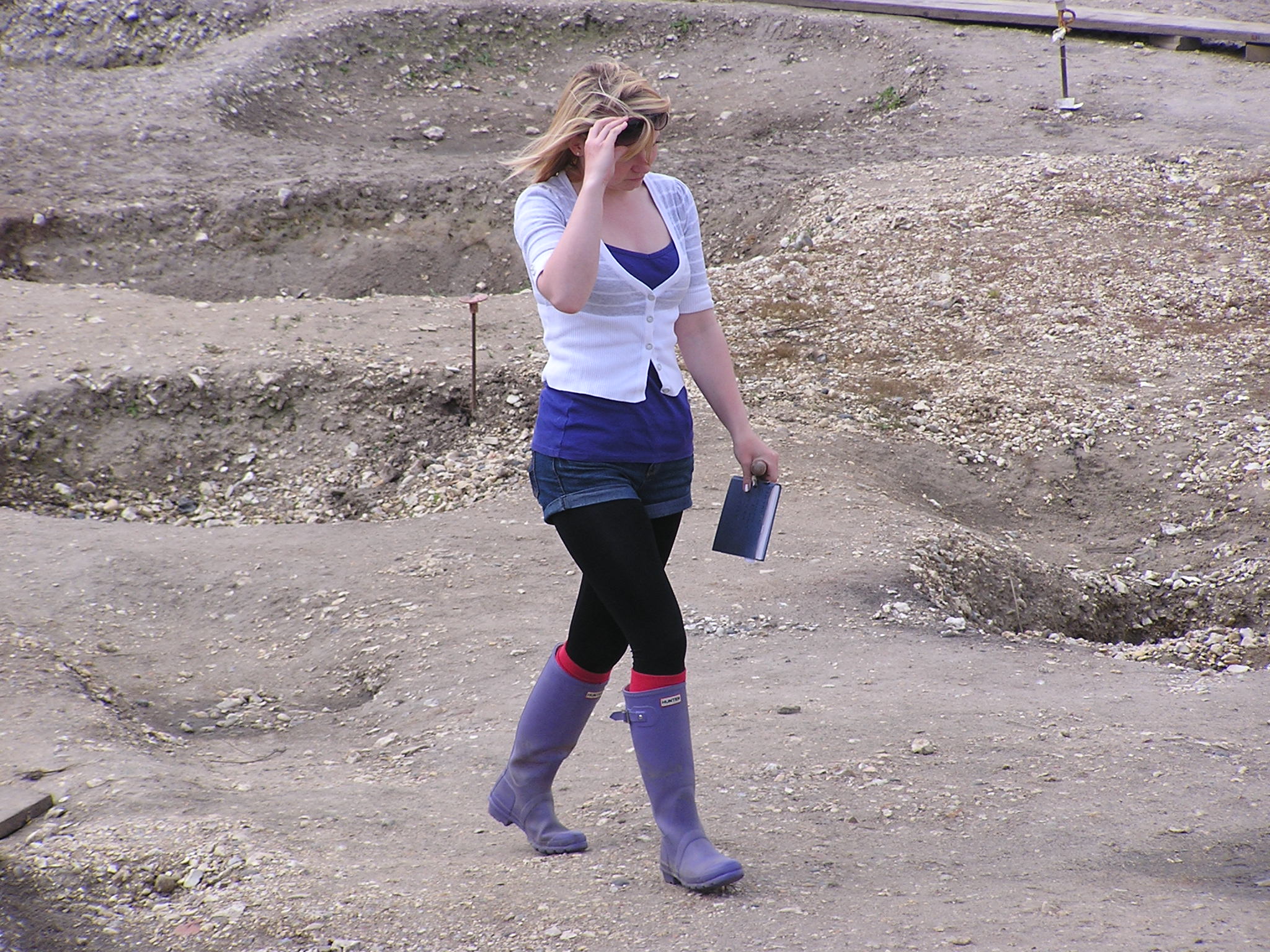
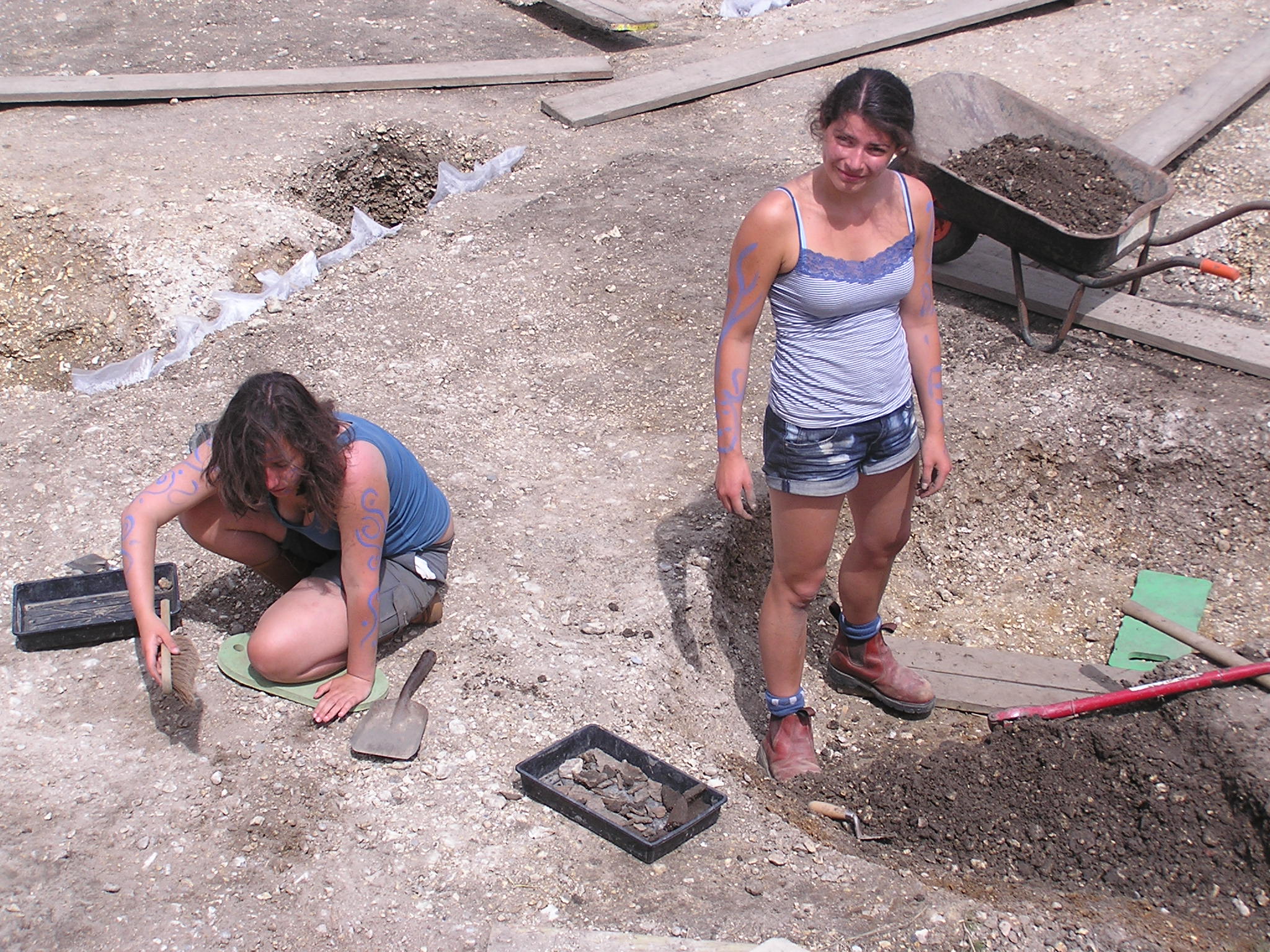
There is an air of Glastonbury surrounding the tented village that arises here each summer. I was amused to see that some of the young and attractive team of diggers (see left) have been daring enough to pose naked for a calendar – ‘without the permission of Reading University’. All profits from Naked Archaeologists are donated to the Silchester Town Life Project and the Inner Hebrides Archaeological Project, in which they are also involved. I particularly like the picture for May. Five girls, clearly perishing cold on what was presumably an early-morning photo-call, are gazing into the city from the south wall. Their shivering backs are adorned with intricate spiral patterns of woad. The caption wittily reads: ‘Boudicca and her warriors plan their attack on the Roman town’. The tableau is historically accurate. According to Roman writers, the Ancient Britons daubed themselves with woad and charged naked into battle. There is also evidence of destruction at Silchester at the exact time of the Boudiccan revolt. I hope these girls know the correct pronunciation of her name: Bow-deeka.

A more questionable image is that for November. Entitled ‘An evening of bar sports in the Calleva Arms’, a naked man, snooker queue in hand, cocks his leg over the side of the table and leans over it as he aims his shot. The Calleva Arms is a family pub so let’s hope the picture was taken out of hours. Otherwise the images are very tasteful, and all the models are undoubtedly good sports.

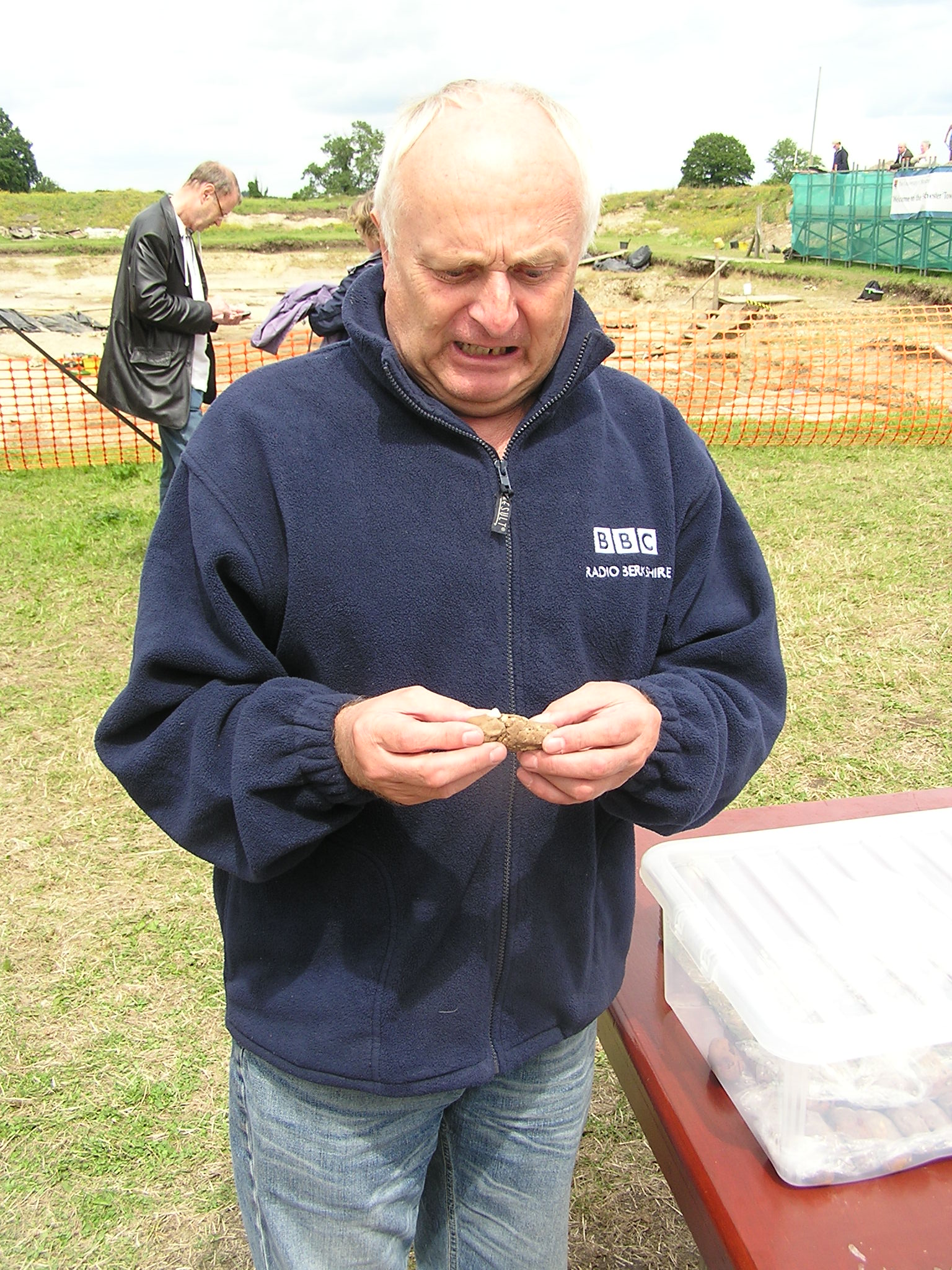
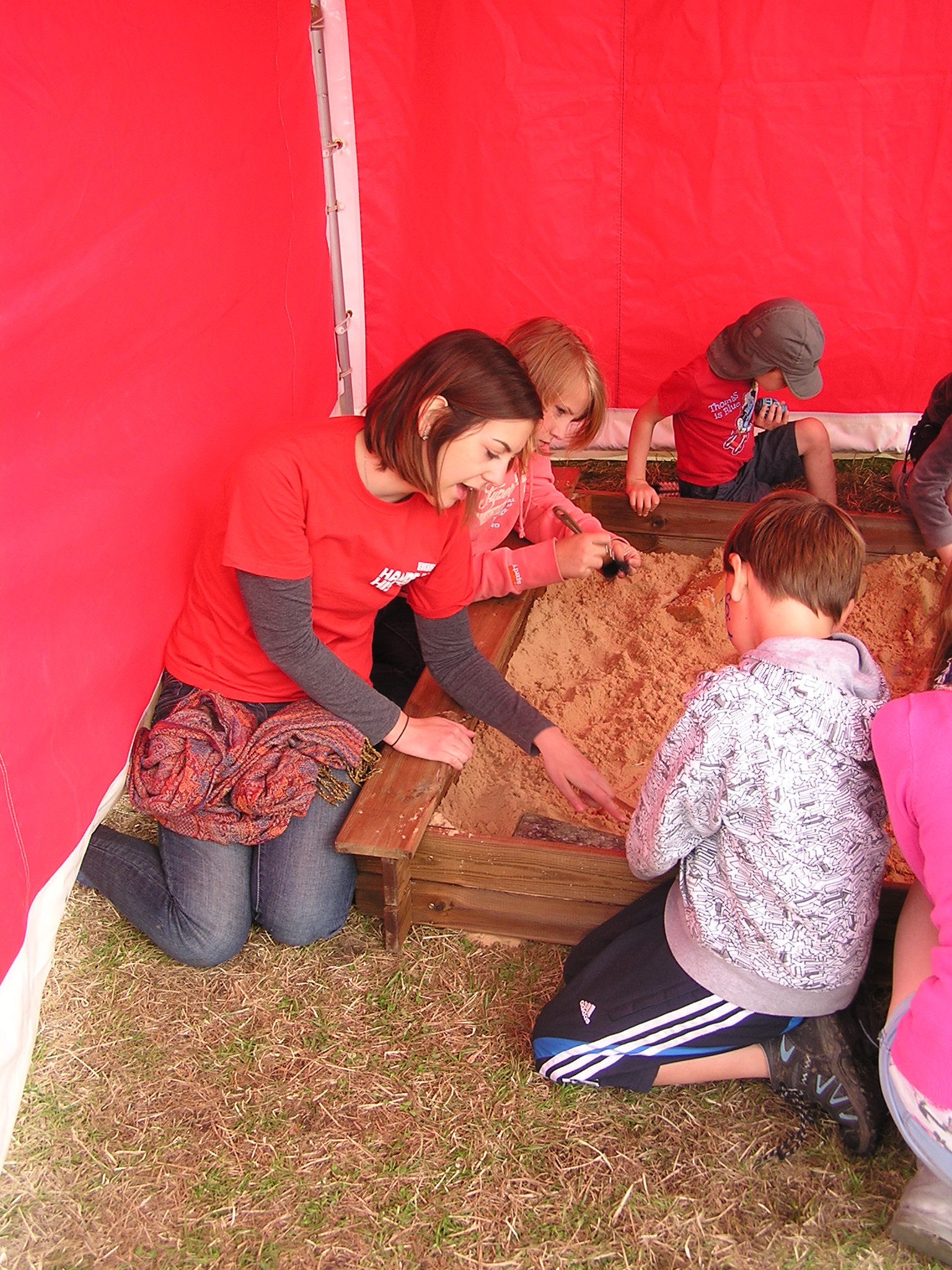
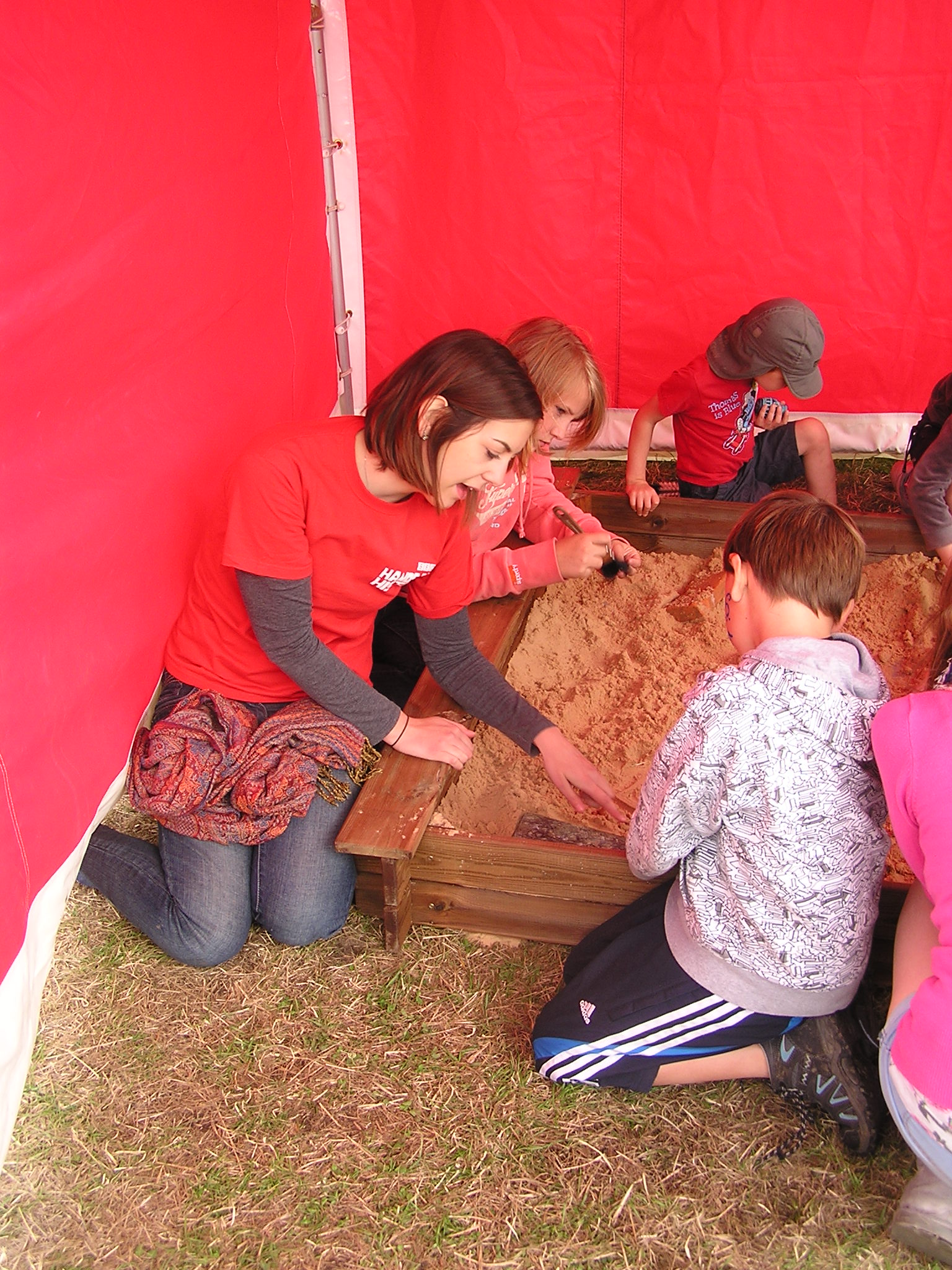
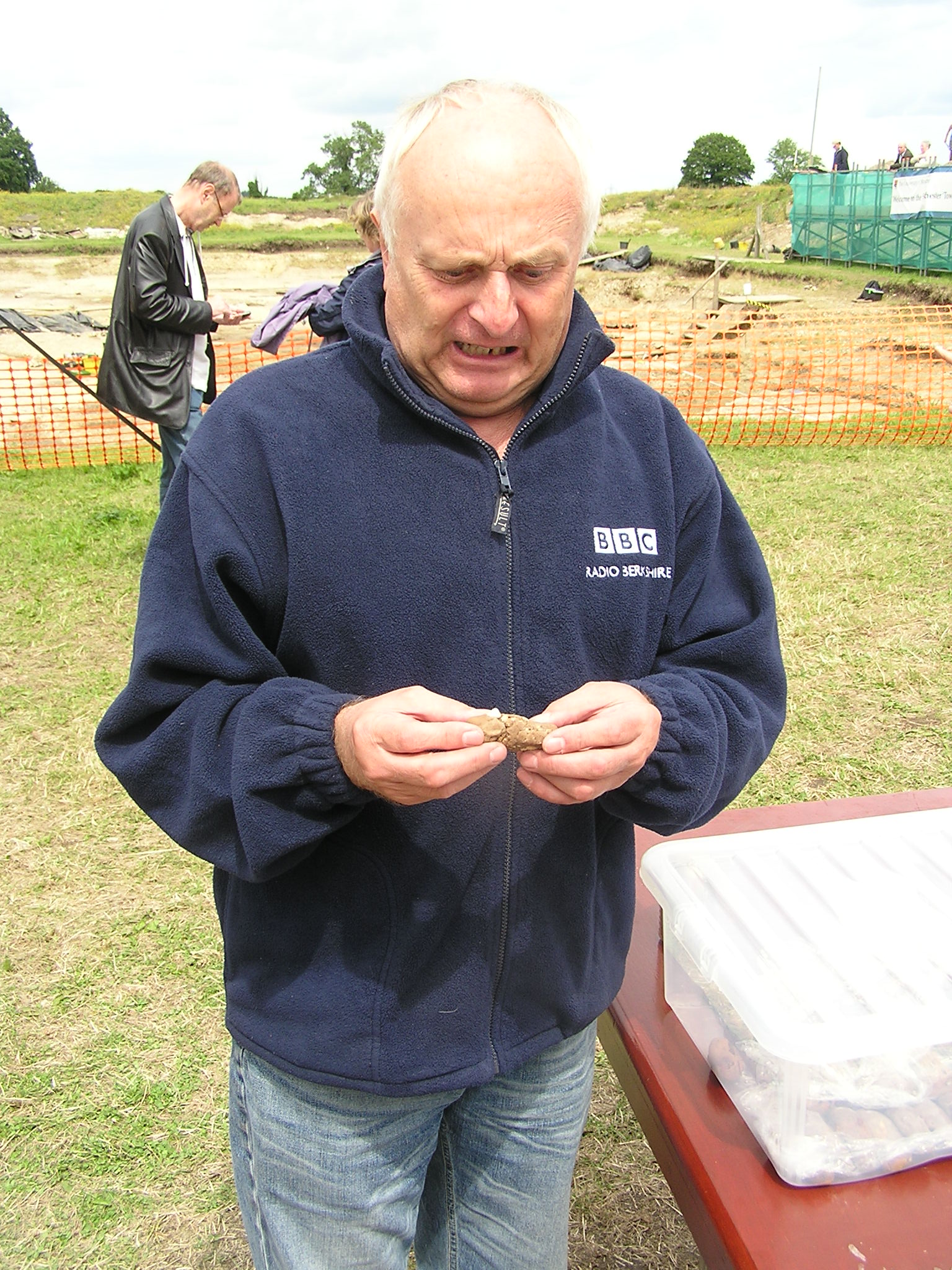
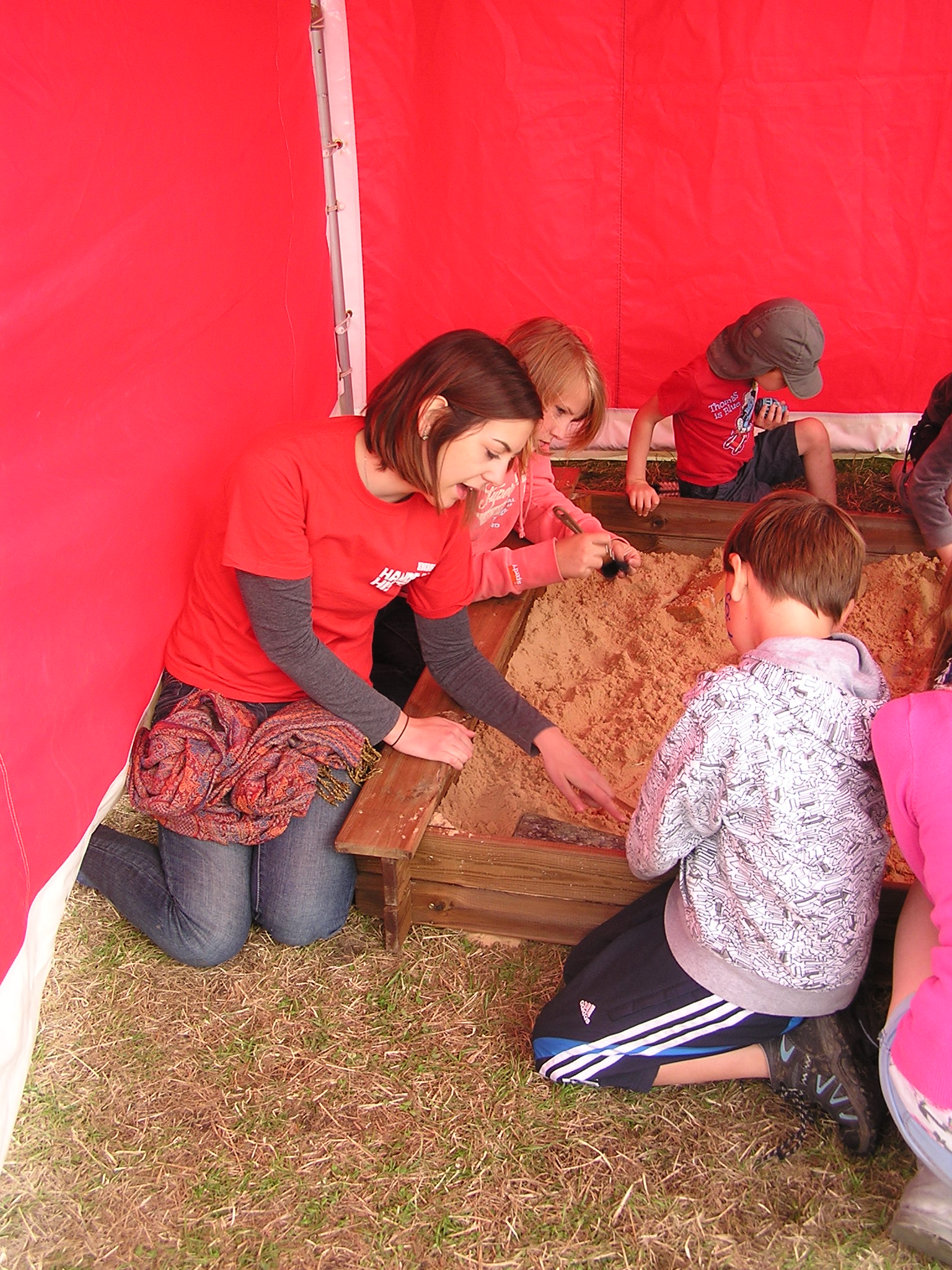
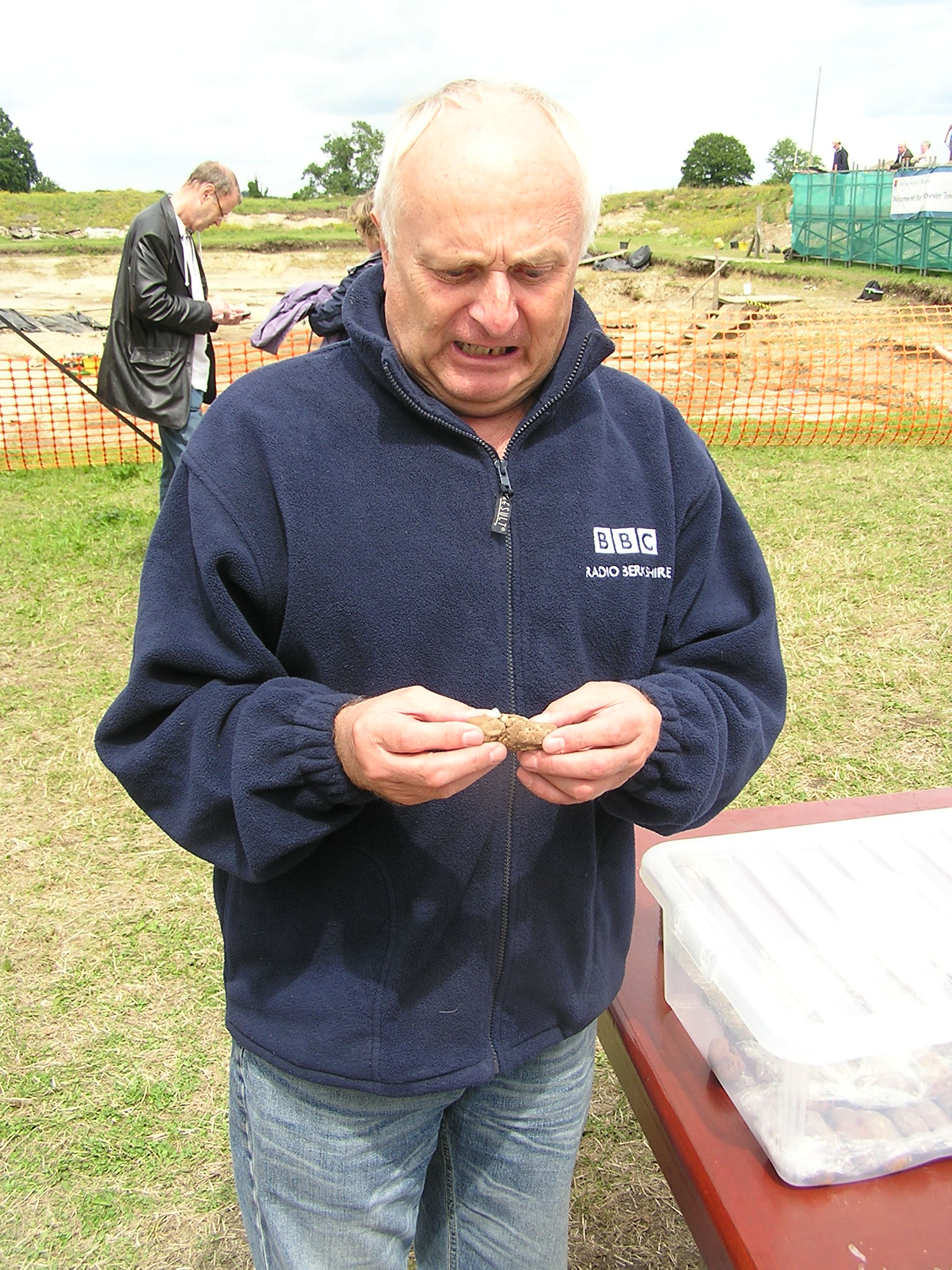
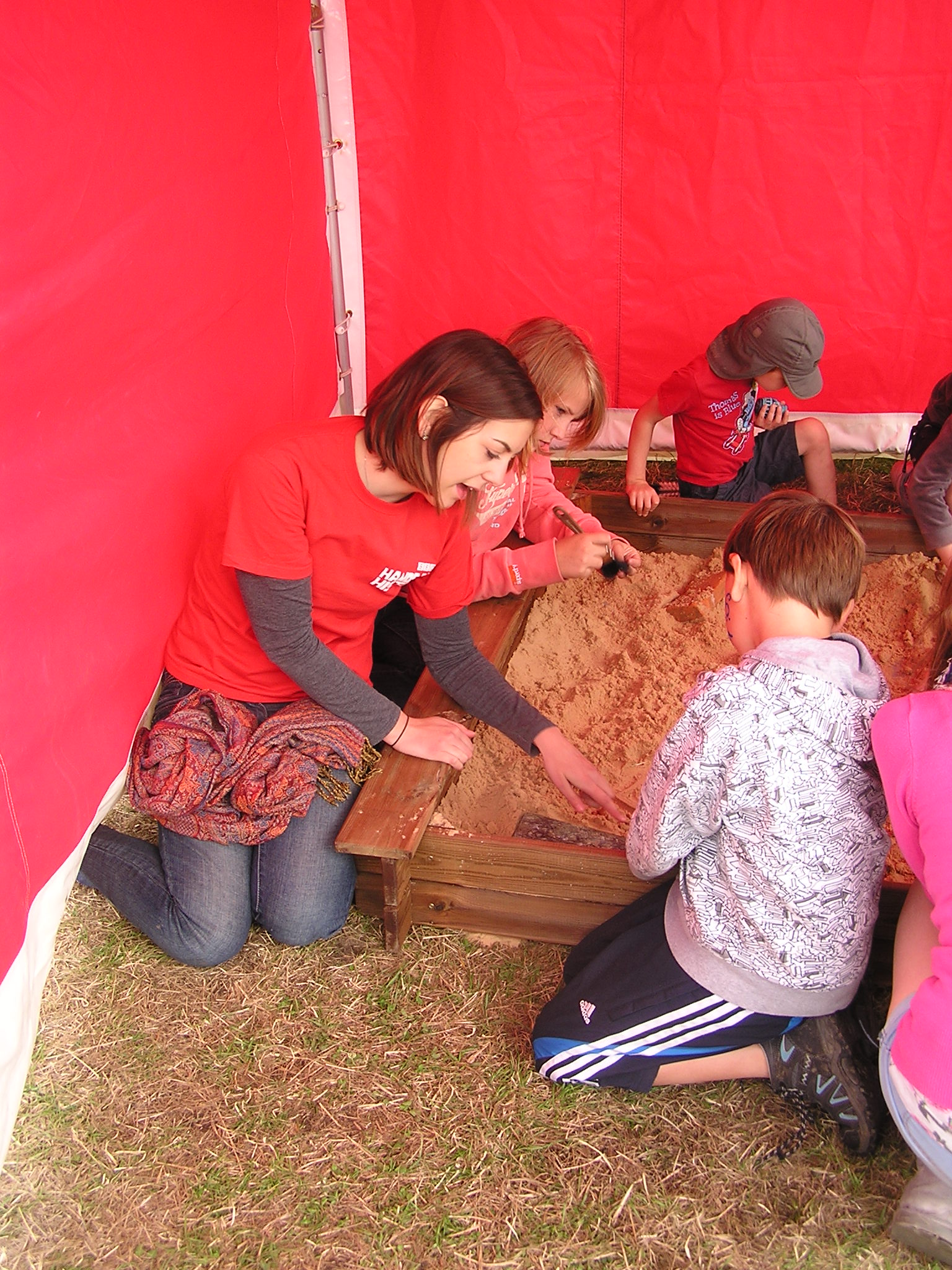
In this picture, Roger Hammett of BBC Learning, based at Southampton, handles a sample of Roman ‘poo’ with a fine air of professional detachment. I hope he was duly grateful to his assistant, Sophia, who had spent hours, the previous day, kneading these unsavoury objects into shape. Introducing passing children to the thrill of archaeology in a sandpit, Sophia (right) showed a considerable knack of engaging with them and instructed them expertly in the significance of their various ‘finds’.

Here Hannah, a budding Oxford Classicist, pauses to rest during a bout of energetic digging, having just nonchalantly excavated a substantial part of the rim of a large bowl. Roman Silchester had a strikingly youthful population, few of whom would have lived beyond the age of thirty. It is touchingly appropriate that their modern counterparts should be uncovering their lives with such energy, grace and commitment.

See also my previous blog on Roman tilers and their literacy in Calleva Atrebatum.