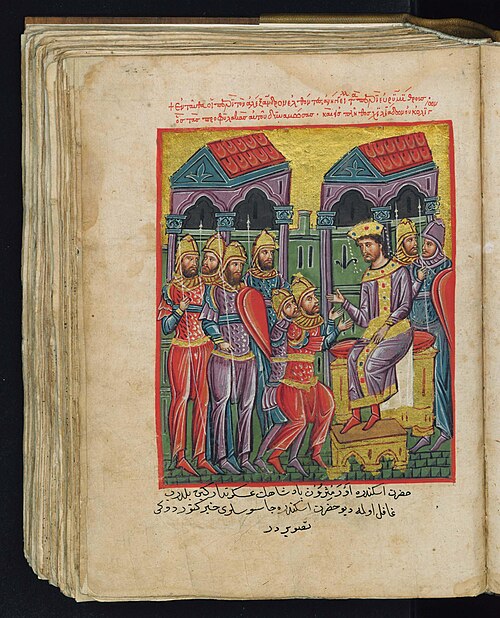
A 14th-century Byzantine version of the Alexander Romance (now in Venice), with Greek and Arabic inscriptions. (Wikicommons)
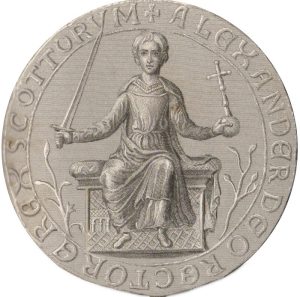
Alexander II, King of Scots, from whom the first Highland Alexanders were named: a Victorian steel engraving taken from his Great Seal. (Wikicommons)
In the first half of the 13th century, the cousins Ewen Mòr, King of the Hebrides, and Donald, Lord of Islay, each diplomatically named one of their sons after Alexander II, the reigning King of Scots, thus popularising the name in the Highlands. The two boys, who grew up to found families of their own, were the first of history’s myriad Alexander MacDougalls and Alexander MacDonalds.
Alexander II was named after a previous king, Alexander I, who was born c.1077. The name was at that time rare, perhaps even unknown, in Scotland, let alone in the Hebrides, whose sovereign was the King of Norway.
As the fifth son of King Malcolm Canmore by his English wife, St Margaret, the future Alexander I was the first of the brood not to receive an English name. It is speculated that he ‘may have been named from the fourth-century Saint whose Day was May 3, or from the Pope who died on April 21, 1073, or, more probably, from the hero of Romance’(1) – that is, Alexander the Great, the most popular hero of the medieval world, whose name resounded as far as the borders of China. In the East they called him Iskander; in the Highlands, the form soon adopted was Alasdair.
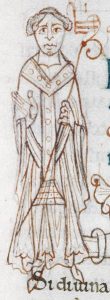
A near-contemporary image of Lanfranc of Bec, wearing the Y-shaped pallium given him by Pope Alexander II (Bodley MS 569, c.1100). (Wikicommons)
The key to the naming of Alexander I, from which all the others followed, was the influence over his mother of Lanfranc, the former Prior of Bec in Normandy, who was appointed Archbishop of Canterbury in 1071. Having been invited by Margaret to be her ‘director’ or spiritual adviser,(2) Lanfranc may have offered his views on suitable Christian names.
The choice of name may have been inspired by the child having been born on the saint’s name-day, 3 May, but there is no record of the event. It so happened that Lanfranc had received his ‘pallium’, or symbolic woollen cloak, from Pope Alexander, who had been his pupil at Bec, so he may have had a soft spot for him. Alternatively, it may be significant that ‘the Library of Bec, in which no other poetical work, not even Virgil, found a place, possessed a Vita Alexandri regis Macedonum …’
Alasdair Mòr MacDougall, Lord of Argyll, the first of the Alexander MacDougalls, was an outstanding prince who truly deserved to be called ‘great’; but it is to the imagination of Lanfranc, and to the irresistible influence of the Normans, that the world’s ‘Alasdairs’ ultimately owe their name.
- David Sellar, Pedigrees, Power and Clanship: Essays on Medieval Scotland, ed. Hector L. MacQueen (Edinburgh, 2025), p.202; R. Andrew McDonald, The Kingdom of the Isles: Scotland’s Western Seaboard, c.1100 – c.1336 (Scottish Historical Review Monographs Series No.4, East Linton, 1997), pp.140-1.
- R.L. Graeme Ritchie, The Normans in Scotland (Edinburgh, 1954), p.393.
- Ibid., p.73.