SERGEANT COLIN CHARLES WORKMAN, R.A.O.C. – A NAME FROM THE ROLL OF HONOUR AT ST JAMES’S CHURCH, BRAMLEY, HANTS. By Rupert Willoughby. Reprinted from the November issue of the Bramley Magazine.
Among the names read out at our annual Remembrance Service is that of Sergeant Colin Charles Workman, Royal Army Ordnance Corps. Born in Southsea, he is commemorated here because of his time at Bramley Ordnance Depot and at its School of Ammunition, where he trained in bomb disposal. He was not a casualty of either World War but of a much later conflict. The nature of that conflict, and Workman’s sacrifice, deserve to be more widely known and understood, beyond the mere echo of his name.
Colin Workman had joined the army in 1958, aged sixteen. In late August 1967, aged 26, he was counting down the final months of a posting to Singapore, especially as his pregnant wife Maureen, an Ulster girl, and their two-year-old son Steven, had already flown back home to co. Antrim. On 24 August, however, he was transferred at short notice to Hong Kong, where there was an urgent demand for his particular skills.
Earlier that year, Mao Tse-tung, the ageing Chairman of the Chinese Communist Party, had proclaimed the ‘Great Proletarian Cultural Revolution’. A deranged megalomaniac, Mao was determined to reassert his faltering authority, and did so by appealing to the youth. Having proved his vigour by swimming across the Yangtse at Wuhan, he unleashed a ‘wasted’ decade of ‘persecution, terrorism and wholesale wanton destruction of China’s past, far more effective than anything ever managed by the Western barbarians’.
Ten million fanatical young Red Guards marched through Beijing, shouting Mao’s praises, and were ‘let loose to destroy the four “olds” – old ideas, old customs, old culture, old habits – all the things that had made China a great civilisation’. Books were ritually denounced and burned; so were the corpses of long-dead emperors. Young people were encouraged also to denounce their parents and teachers.
In a notorious incident in August (mention of which is banned in present-day China), a 50-year-old teacher in a Peking (Beijing) girls’ high school, Bian Zhongyun, had been subjected to prolonged torture by her young female charges. Her crime? To suggest that a portrait of Mao be left in place in the event of evacuation for a fire. Eventually, having been beaten senseless with nailed clubs, she had been left to die on a rubbish cart in the hot sun, while her killers, well pleased with themselves, had gone off to buy ice lollies.
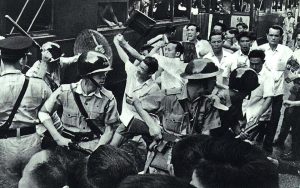
By the spring of 1967, the effects of the upheaval were being felt in Hong Kong. Posters began to appear bearing virulently anti-British sentiments, such as ‘Stew the White-Skinned Pig’ and ‘Fry the Yellow Running Dog’. The Bank of China brazenly broadcast propaganda from the roof of its building; the British authorities set up their own speakers nearby and countered with Cantonese opera at full volume. Violent demonstrations took place in May and, on 7 July, Chinese People’s Militia spilled across the border at Sha Tau Kok. When they opened fire on police with machine-guns, killing five and wounding eleven, it seemed to be the prelude to an invasion.
In reality, the Colony could have been brought to its knees at any time; China had merely to cut off its water supply. The crafty Mao and his ministers did not intend to take it back ‘ahead of time’, which would have been economically and politically disastrous, but rather ‘to stir up enough trouble to provoke reprisals, and then a kowtow, from the British’.
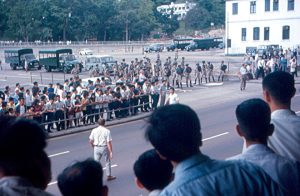
The rioters (just out of the picture) are said to have been outnumbered by the curious bystanders. Hong Kong, 21 May 1967 (Wiki)
Their designs were thwarted by the conspicuous lack of support for the Communists in Hong Kong, apart from a minority of trades unionists and some of the bored and disaffected youth of the tenements; the rioters, waving their copies of the infamous ‘Little Red Book’ or Thoughts of Chairman Mao, were typically outnumbered by the bystanders, who would assemble at close quarters to view the drama. Moreover, the British were admirably restrained in their response; for example, Gurkhas sent in to Sha Tau Kok were instructed not to answer the fire of the militiamen, but to respond instead with white phosphorus and tear-gas grenades. The Governor himself, Sir David Trench, set a fine example of sang-froid, continuing, ‘with aplomb, to play golf at Fanling’, the gubernatorial residence that was only a few miles from the open border at Sha Tau Kok.
The demonstrations having failed to elicit the desired response, the activists had resorted instead to a bombing campaign. 1,167 explosive devices, said to have been assembled in the classrooms of left-wing schools, were planted in the Colony. There were nine fatalities, the first, on 20 Aug 1967, being an 8-year-old Chinese girl and her 2-year-old brother; they were killed by a bomb that had been cruelly disguised as a gift.
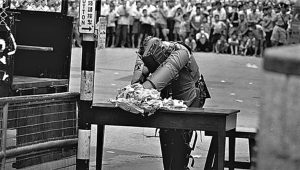
A prurient crowd assembles to see a British Army bomb disposal expert at work
In order to deal with such a threat, it was necessary to bring in suitably qualified men with nerves of steel. Again, despite the loud-speaker warnings of Royal Signallers, large crowds of men, women and children would assemble at no great distance to watch the heavily-padded army bomb disposal experts at work, presumably in anticipation of an horrific spectacle. Most of the bombs were indeed successfully defused. A fireman, Aslam Khan, was killed while unpicking a homemade device that suddenly went off; on another occasion, a terrorist was killed by his own bomb.
It was on 28 August, only his fourth day in the Colony, that young Workman was sent to dismantle another booby trap, this time on the Lion Rock that overlooked Kai Tak Airport. The bomb exploded and, in front of many witnesses, he was blown 200 feet over the side of the cliff. His wife and her father flew to Hong Kong for the funeral, Maureen living to receive his posthumous award of an Elizabeth Cross in 2010.
Heaven help Hong Kong that is now ruled by the same, unrepentant Chinese Communist Party, and may Sergeant Workman’s sacrifice be ever remembered.